Mesoamerica · Culture
Nahua
Nahua (Nāhuatl-speaking peoples)
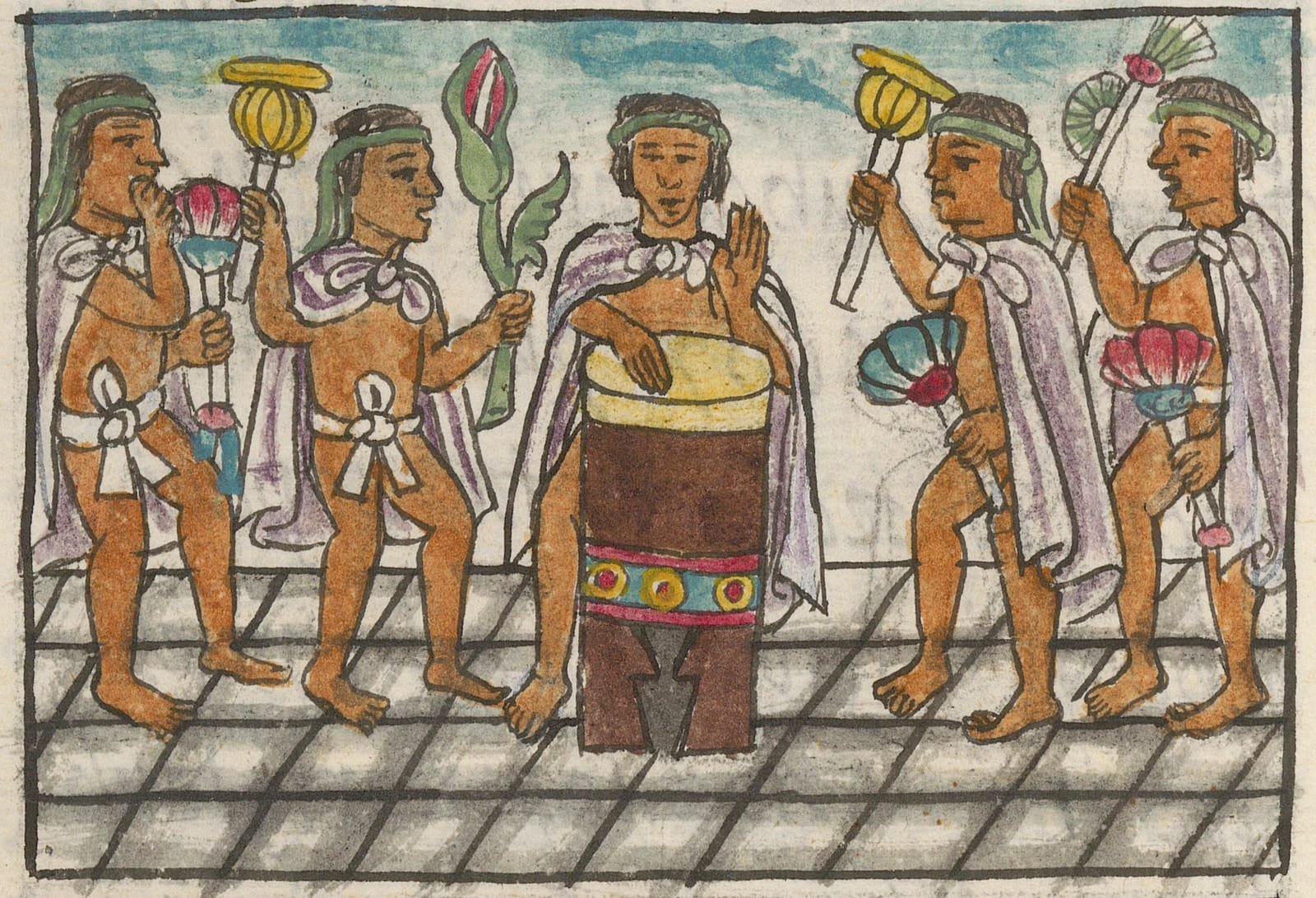
A ceremonial scene from Book 9 of the Florentine Codex (1577) — the same book that records mushrooms served at a merchants' feast. — Nahua artists under Bernardino de Sahagún (attrib. Alonso Vegerano) · Public domain · Source
The people and the record
“Nahua” names the Nahuatl-speaking peoples of central Mexico — among them the Mexica, whose empire the Spanish conquered in 1521. Their advantage, for an archive like this, is documentary: the Nahua world was written down early, both by Spanish friars and by Nahua authors themselves, giving the mushroom a primary-text foundation that few traditions can match.
Teonanácatl in the Florentine Codex
The Florentine Codex, compiled under Bernardino de Sahagún with Nahua collaborators around 1577, preserves a vivid passage in Book 9: banquet guests eat “little black mushrooms” that intoxicate them and bring visions, laughter, and weeping.1 Book 11 records the word teonanácatl. This is not modern psychedelic nostalgia projected backward; it is a sixteenth-century account, part-authored by Nahua hands, of mushrooms used within feast and ritual.
Thunderbolt medicine
The most interesting recent argument is that Nahua mushroom use survives inside a larger logic of lightning and rain. Scholars describe ritual specialists who are called — marked by lightning, dreams, visions, or persistent illness — rather than self-appointed, and a medicine in which mushrooms are tied to storm, water, and fertility.2 The association is not arbitrary: mushrooms erupt with the rains, and the fungal body is bound to a divine meteorology reaching back to rain deities of the Tlaloc complex.
Not one isolated sacrament
Nahua entheogenic medicine can be multi-substance: mushrooms are reported in combination with other ritual plants such as yauhtli (Mexican tarragon, Tagetes lucida).2 Keeping that complexity visible matters, because it resists collapsing a whole therapeutic world into the single Western category of “the mushroom trip.”
Colonialism, and today
Denounced as idolatry in the colonial period and controlled as a narcotic in the modern one, Nahua mushroom practice nonetheless persists in places — and current scholarship describes it as endangered. It survives as a living tradition under pressure, not a recovered fossil.
Footnotes
The record
Names of the mushroom
| Name | Language | Translation / gloss |
|---|---|---|
| teonanácatl † | Nahuatl | read variously as ‘flesh of the gods’ or ‘sacred/marvellous mushroom’; the exact gloss is debated |
| teotlaquilnanácatl † | Nahuatl (contemporary) | a present-day Nahua name for Psilocybe caerulescens; gloss reconstructed |
| apipiltzin † | Nahuatl (contemporary) | — |
Indigenous- and local-language names appear in many spellings across dialects, publications, and orthographies. We record them as given in our sources and do not standardise them or invent translations. A dagger (†) marks a form our sources flag as uncertain.
Historical record
- c. 1577
The Florentine Codex
Sahagún's Nahua collaborators describe banquet guests eating 'little black mushrooms' that intoxicate and bring visions (Book 9), and record the word teonanácatl (Book 11).
Historical - 16th c. onward
Suppression as idolatry
Missionaries denounce mushroom rites; practice retreats from public view.
Historical - 1938–2008
Species identified
Schultes and later Gastón Guzmán connect colonial terms to specific modern species.
Later scholarly interpretation - 2020s
Thunderbolt medicine
Recent scholarship frames living Nahua mushroom use within a wider medicine of lightning, rain, and dreams — now endangered.
Living
Evidence
The support for this entry, separated by kind. Different kinds of evidence carry different weight.
- Colonial text
- The Florentine Codex (Books 9 & 11), a sixteenth-century Nahua-authored source.
- Later scholarly interpretation
- Species attributions by Schultes and Guzmán mapping colonial terms onto modern taxonomy.
- Contemporary ethnography
- Contemporary scholarship on Nahua thunderbolt medicine (e.g. González Romero, 2025).
- Linguistic evidence
- Living Nahuatl mushroom names such as teotlaquilnanácatl and apipiltzin.
What remains uncertain
- Which species the colonial texts describe is a reconstruction; early writers rarely recorded diagnostic detail.
Sources & editorial record
Sources & further reading
Bernardino de Sahagún & and Nahua authors of the Colegio de Santa Cruz de Tlatelolco (c. 1577). Florentine Codex (General History of the Things of New Spain), Books 9 & 11. Digital Florentine Codex, Getty Research Institute.
Sixteenth-century Nahua-authored account describing banquet guests eating "little black mushrooms" that intoxicate and bring visions.
Gastón Guzmán (2008). Hallucinogenic Mushrooms in Mexico: An Overview. Economic Botany 62(3).
Species-level overview; identifies P. caerulescens (Nahua teotlaquilnanácatl) among ceremonially used mushrooms and counts Indigenous peoples with recorded use.
Osiris Sinuhé González Romero (2025). The Healing Thunderbolt: Nahua entheogenic medicine and lightning. Harvard Divinity School, Psychedelic Intersections.
Frames contemporary Nahua mushroom use within a thunderbolt/rain medicinal complex, sometimes combined with yauhtli (Tagetes lucida).
Richard Evans Schultes (1940). Teonanácatl: The Narcotic Mushroom of the Aztecs. American Anthropologist / Botanical Museum Leaflets, Harvard.
The paper that reconnected the colonial word teonanácatl to living Oaxacan mushroom use, drawing on Schultes’ 1938–39 fieldwork among Mazatec, Chinantec, and Zapotec communities.
Congreso de la Unión (current). Ley General de Salud (arts. 234, 245). Cámara de Diputados, Mexico.
Lists psilocybin and hallucinogenic mushrooms, including Psilocybe mexicana, as controlled substances.
Editorial record
Corrections history
No corrections recorded yet. Spotted an error or a mischaracterisation? See how corrections work.
Last reviewed