Mesoamerica · Culture
Zapotec
Binnizá / Bene Xon (self-designations vary by region)
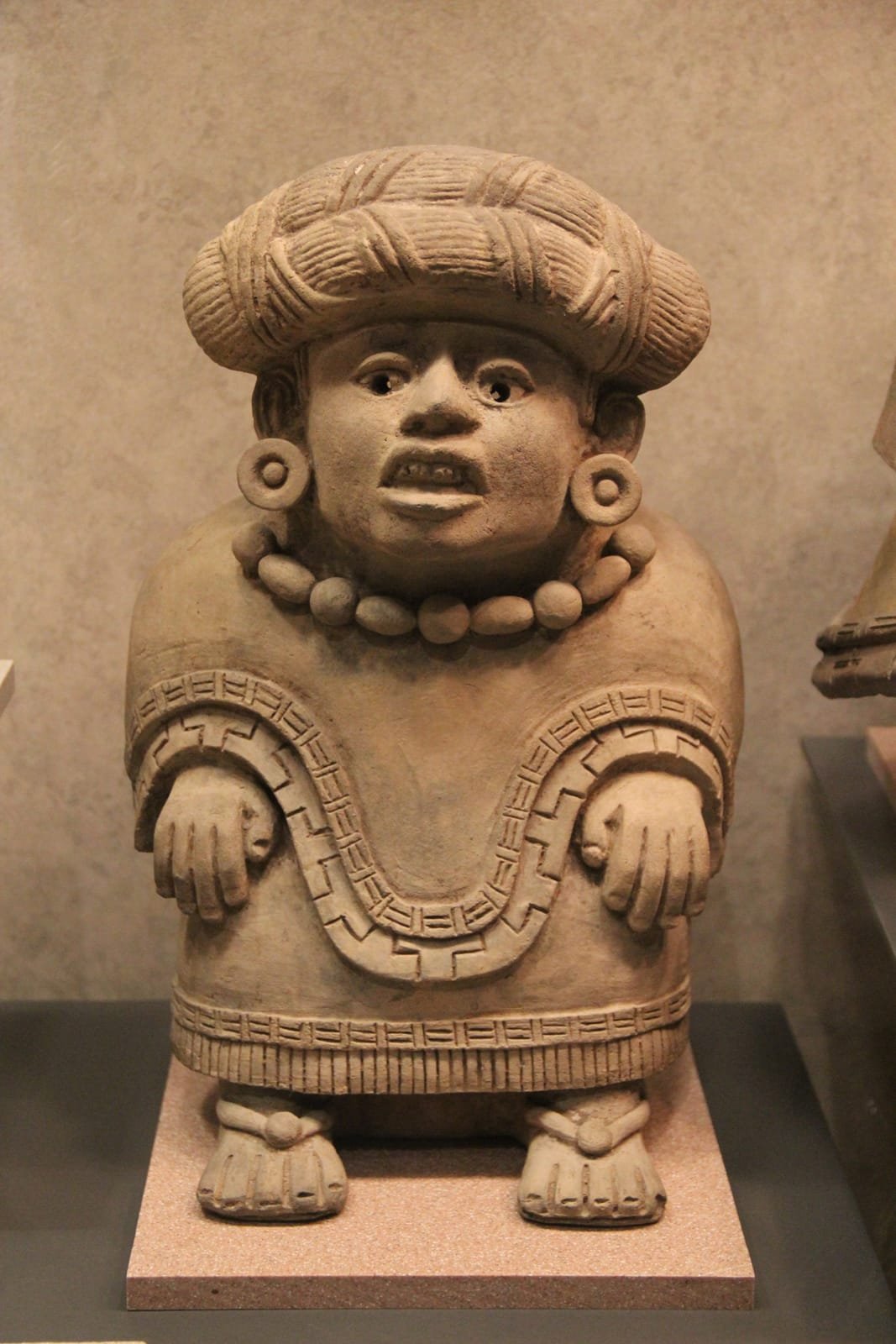
A Zapotec ceramic urn from Monte Albán — the seated deity-figure that is the signature Zapotec art form. — Museum object, via Wikimedia Commons · CC0 (public domain) · Source
The people and the landscape
The Zapotec (Binnizá, “cloud people,” among other self-designations) are one of Oaxaca’s largest Indigenous nations, with a civilisation reaching back to Monte Albán. What follows is one recently documented case in the Valles Centrales — not a portrait of every Zapotec community, whose relationships to these mushrooms vary.
The mushroom and its names
A 2025 ethnographic study from El Peral, in San Antonino El Alto, documented living ritual use of Psilocybe zapotecorum under the Zapotec name Ni’to be’ya and the Spanish names Hongo Santo and Hongo Borracho.1 Using all three together is deliberate: it signals the linguistic depth of the practice and resists flattening it into imported “magic mushroom” vocabulary.
Ritual handling: copal and the altar
The study’s strongest public-facing detail is concrete and undramatic. Doses are laid on leaves, sold in local markets, and incensed with copal before the altar of San Miguel Arcángel before use.1 That single image — mushroom, smoke, saint — makes the ritual visible without sensationalising it, and shows how thoroughly the practice is woven into rural Catholic-Zapotec devotional life.
Healing and divination
The mushrooms’ value here is not recreational intensity but relational efficacy: in the local frame, the mushroom can do what is asked of it through ritual. Community members are aware that outsiders often use such mushrooms recreationally, but that is not the register in which the practice is held at El Peral.
Fragile continuity
The researchers report the practice as continuing but decreasing, with interviewees linking the mushrooms’ growing scarcity to changing climate, and the study situates its findings against a backdrop of psychedelic tourism and commodification. This is a living tradition, freshly documented, and already under strain.
Footnotes
The record
Names of the mushroom
| Name | Language | Translation / gloss |
|---|---|---|
| Ni'to be'ya † | Zapotec | ‘holy mushroom’ (approximate) |
| Ni'to be † | Zapotec | — |
| Hongo Santo | Spanish | holy mushroom |
| Hongo Borracho | Spanish | drunken mushroom |
Indigenous- and local-language names appear in many spellings across dialects, publications, and orthographies. We record them as given in our sources and do not standardise them or invent translations. A dagger (†) marks a form our sources flag as uncertain.
Historical record
- 1938–39
Schultes' early notes
Schultes records mushroom use among Zapotec, alongside Mazatec and Chinantec communities.
Historical - 2025
Formal contemporary documentation
An ethnographic study from El Peral records living ritual use of Psilocybe zapotecorum, explicitly filling a gap left by scholarship's focus on Mazatec territory.
Living
Evidence
The support for this entry, separated by kind. Different kinds of evidence carry different weight.
- Contemporary ethnography
- The 2025 study of ritual Psilocybe zapotecorum use at El Peral, San Antonino El Alto (IMA Fungus).
- Linguistic evidence
- Zapotec names Ni'to be'ya / Ni'to be, recorded with the caution that local terminology varies.
- Firsthand testimony
- Interviews with community members describing handling, sale, and ritual use.
What remains uncertain
- The published record is recent and geographically specific; it should not be generalised to all Zapotec communities.
Sources & editorial record
Sources & further reading
A. Sánchez-Ramírez & and colleagues (2025). Ritual use of Psilocybe zapotecorum in a Zapotec community of the Valles Centrales, Oaxaca. IMA Fungus.
Contemporary ethnography from El Peral, San Antonino El Alto — documents Ni’to be’ya / Hongo Santo / Hongo Borracho used for healing and divination, incensed with copal before the altar of San Miguel Arcángel.
Richard Evans Schultes (1940). Teonanácatl: The Narcotic Mushroom of the Aztecs. American Anthropologist / Botanical Museum Leaflets, Harvard.
The paper that reconnected the colonial word teonanácatl to living Oaxacan mushroom use, drawing on Schultes’ 1938–39 fieldwork among Mazatec, Chinantec, and Zapotec communities.
Gastón Guzmán (2008). Hallucinogenic Mushrooms in Mexico: An Overview. Economic Botany 62(3).
Species-level overview; identifies P. caerulescens (Nahua teotlaquilnanácatl) among ceremonially used mushrooms and counts Indigenous peoples with recorded use.
Congreso de la Unión (current). Ley General de Salud (arts. 234, 245). Cámara de Diputados, Mexico.
Lists psilocybin and hallucinogenic mushrooms, including Psilocybe mexicana, as controlled substances.
Editorial record
Corrections history
No corrections recorded yet. Spotted an error or a mischaracterisation? See how corrections work.
Last reviewed