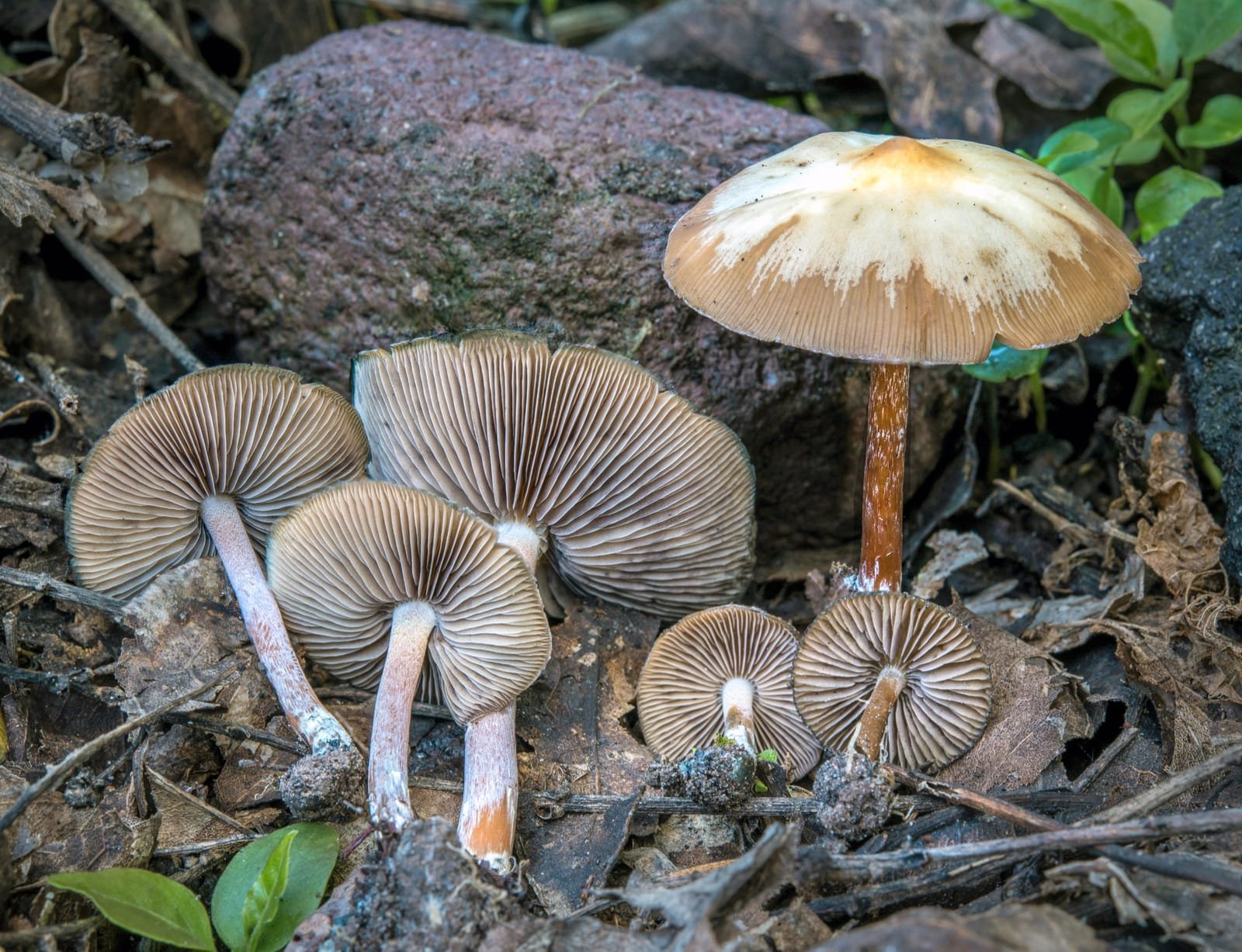
Psilocybin · Species
Psilocybe caerulescens
Murrill, 1923 · Derrumbe, landslide mushroom
The 'landslide mushroom' of highland Mexico — the derrumbe — central to Mazatec veladas and identified with the Nahua name teotlaquilnanácatl.
Identification, in outline
A medium, brown, moisture-loving mushroom of open disturbed ground, bruising blue where bruised, with a broadly conic-to-flattened cap. It takes its Spanish name, derrumbe, from its habit of appearing on the raw earth of landslides and slumps.
Small brown mushrooms are notoriously easy to confuse with one another, and with dangerous species; misidentification is the real hazard.
Ecology and habitat
Unlike species that favour undisturbed forest floor, P. caerulescens is an opportunist of broken ground. Its appearance on landslides gives it a natural association with earth, water, and the violence of the rainy season — the same meteorological world in which highland Mexican mushroom traditions place thunder and rain powers.
Cultural associations
Gastón Guzmán’s overview identifies P. caerulescens, known among present-day Nahua communities as teotlaquilnanácatl, as a strong candidate for a ceremonially used mushroom of the colonial record.1 It is also among the species used in Mazatec veladas; several accounts associate it with María Sabina’s ceremonies.
Active compounds
Psilocybin and psilocin, in concentrations that vary between populations and fruitings.
Toxicity and safety
Not amatoxic, but easily confused with dangerous lookalikes, and controlled under Mexican federal law like other psilocybin mushrooms.
Footnotes
-
Guzmán, “Hallucinogenic Mushrooms in Mexico: An Overview,” Economic Botany (2008). ↩
The record
Local names
| Name | Language | Translation / gloss |
|---|---|---|
| teotlaquilnanácatl † | Nahuatl (contemporary) | roughly ‘divine mushroom that paints/adorns’ — elements teotl + tlàcuilo + nanácatl |
| hongo de derrumbe | Spanish (local) | mushroom of the landslide |
Indigenous- and local-language names appear in many spellings across dialects, publications, and orthographies. We record them as given in our sources and do not standardise them or invent translations. A dagger (†) marks a form our sources flag as uncertain.
What remains uncertain
- ‘P. caerulescens’ covers a complex of closely related forms whose boundaries mycologists still debate.
Sources & editorial record
Sources & further reading
Gastón Guzmán (2008). Hallucinogenic Mushrooms in Mexico: An Overview. Economic Botany 62(3).
Species-level overview; identifies P. caerulescens (Nahua teotlaquilnanácatl) among ceremonially used mushrooms and counts Indigenous peoples with recorded use.
Richard Evans Schultes (1940). Teonanácatl: The Narcotic Mushroom of the Aztecs. American Anthropologist / Botanical Museum Leaflets, Harvard.
The paper that reconnected the colonial word teonanácatl to living Oaxacan mushroom use, drawing on Schultes’ 1938–39 fieldwork among Mazatec, Chinantec, and Zapotec communities.
Roger Heim & R. Gordon Wasson (1958). Les champignons hallucinogènes du Mexique. Muséum national d’Histoire naturelle, Paris.
Heim’s mycological identification of the Oaxacan sacred species alongside Wasson’s ethnographic notes.
Congreso de la Unión (current). Ley General de Salud (arts. 234, 245). Cámara de Diputados, Mexico.
Lists psilocybin and hallucinogenic mushrooms, including Psilocybe mexicana, as controlled substances.
Editorial record
Corrections history
No corrections recorded yet. Spotted an error or a mischaracterisation? See how corrections work.
Last reviewed
A cultural and historical record — not a foraging, cultivation, or consumption guide.