Psilocybin · Species
Psilocybe mexicana
R. Heim, 1957 · Pajarito, teonanácatl (applied broadly)
The small Oaxacan mushroom from which psilocybin was first isolated, and one of the species addressed as niños santos in Mazatec ceremony.
Identification, in outline
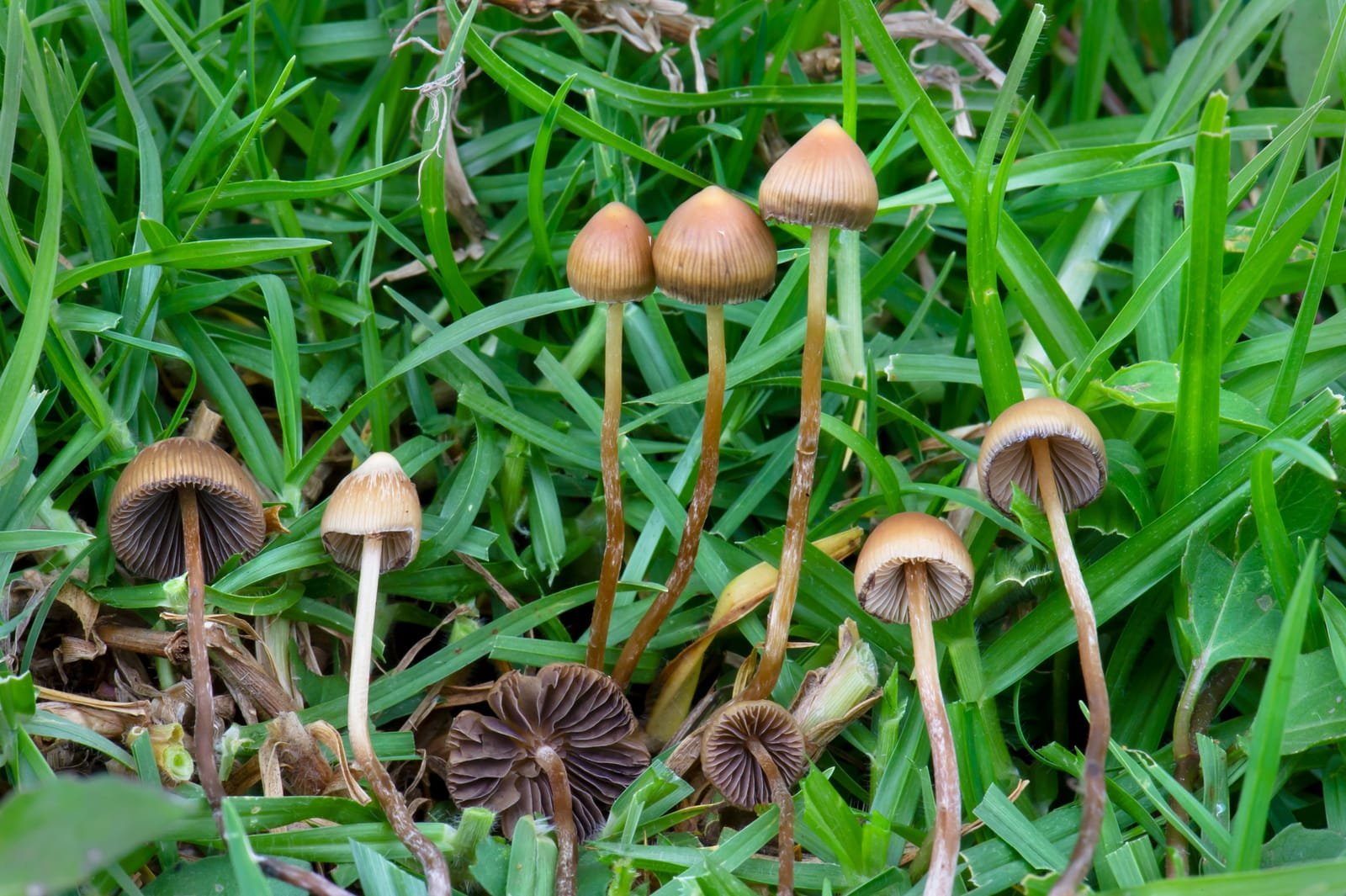
Psilocybe mexicana is a small, slender, tawny-to-straw-coloured mushroom with a conic-to-bell-shaped cap seldom wider than a few centimetres, a thin fragile stem, and — like other members of its genus — a tendency to bruise bluish where handled. It is one of dozens of superficially similar little brown mushrooms that share its habitats.
Field identification of small Psilocybe is genuinely hazardous: several dangerously toxic genera produce near-identical fruitbodies, so misidentification — not the mushroom itself — is the main physical danger.
Ecology and habitat
The species fruits in the rainy season in montane grassland, on mossy banks, and along the edges of oak and pine–oak forest, generally in soil rather than directly on wood or dung. Its emergence with the summer rains is part of why, across highland Mexico, sacred mushrooms are so often bound up with storm, water, and rain-bringing powers.
Cultural associations
P. mexicana is among the species gathered and addressed as niños santos (“holy children”) in the Mazatec velada, and it belongs to the wider Mesoamerican complex that colonial Nahuatl sources called teonanácatl. It is not the only mushroom used in these traditions — Mazatec and neighbouring practitioners recognise several — but it is the one most tightly woven into the modern scientific and popular record.
A note in the history of science
In 1958 the chemist Albert Hofmann isolated and named psilocybin and psilocin from material of this species supplied through Roger Heim and R. Gordon Wasson.1 It was a turning point: a ceremonial Oaxacan mushroom became a named molecule in European laboratories, carrying with it every question of extraction and appropriation that shift implies.
Active compounds
The principal psychoactive constituent is psilocybin, a tryptamine that the body converts to psilocin; baeocystin and related compounds occur in smaller amounts. Concentrations vary widely between fruitbodies and populations.
Toxicity and safety
Psilocybin-containing mushrooms are not “poisonous” in the way that amatoxin-bearing species are, but that distinction is easy to abuse. The real dangers are misidentification (deadly species can look similar), the legal status of psilocybin, and the medical and psychological risks of unsupervised use. In Mexico, psilocybin and hallucinogenic mushrooms — P. mexicana among them — are listed as controlled substances.2
Conservation
The species is not globally rare, but localised pressures — intensive gathering for tourism around some Oaxacan communities, and shifting rainfall — are reported by researchers and community members alike as reasons the mushrooms are harder to find than they once were.
Footnotes
The record
Local names
| Name | Language | Translation / gloss |
|---|---|---|
| teonanácatl † | Nahuatl | ‘flesh of the gods’ / ‘sacred mushroom’ (a collective term, not a species name) |
| pajarito | Spanish (local) | little bird |
Indigenous- and local-language names appear in many spellings across dialects, publications, and orthographies. We record them as given in our sources and do not standardise them or invent translations. A dagger (†) marks a form our sources flag as uncertain.
What remains uncertain
- The colonial word teonanácatl names a *category* of sacred mushrooms, not this species specifically; mapping sixteenth-century terms onto modern taxonomy always involves reconstruction.
Sources & editorial record
Sources & further reading
Richard Evans Schultes (1940). Teonanácatl: The Narcotic Mushroom of the Aztecs. American Anthropologist / Botanical Museum Leaflets, Harvard.
The paper that reconnected the colonial word teonanácatl to living Oaxacan mushroom use, drawing on Schultes’ 1938–39 fieldwork among Mazatec, Chinantec, and Zapotec communities.
Roger Heim & R. Gordon Wasson (1958). Les champignons hallucinogènes du Mexique. Muséum national d’Histoire naturelle, Paris.
Heim’s mycological identification of the Oaxacan sacred species alongside Wasson’s ethnographic notes.
Gastón Guzmán (2008). Hallucinogenic Mushrooms in Mexico: An Overview. Economic Botany 62(3).
Species-level overview; identifies P. caerulescens (Nahua teotlaquilnanácatl) among ceremonially used mushrooms and counts Indigenous peoples with recorded use.
R. Gordon Wasson (1957). Seeking the Magic Mushroom. Life Magazine, 13 May 1957.
The mass-market article that exposed the Mazatec velada to a global audience and set the tourism and commodification pressures that followed.
Congreso de la Unión (current). Ley General de Salud (arts. 234, 245). Cámara de Diputados, Mexico.
Lists psilocybin and hallucinogenic mushrooms, including Psilocybe mexicana, as controlled substances.
Editorial record
Corrections history
No corrections recorded yet. Spotted an error or a mischaracterisation? See how corrections work.
Last reviewed
A cultural and historical record — not a foraging, cultivation, or consumption guide.