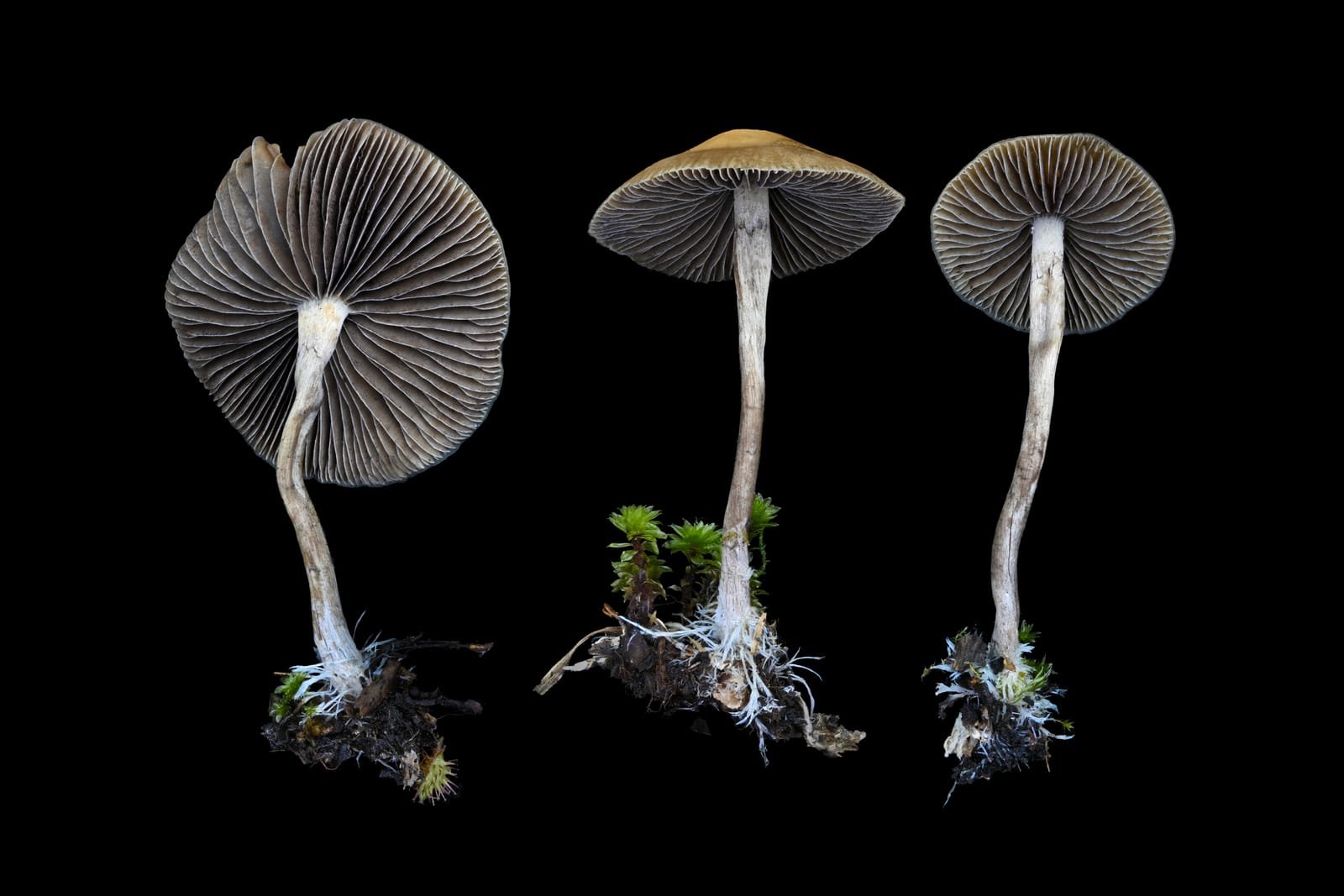
Psilocybin · Species
Psilocybe aztecorum
R. Heim, 1957 · apipiltzin (local Nahuatl)
A high-altitude mushroom of central Mexico's great volcanoes, recorded among contemporary Nahua under the name apipiltzin.
Identification, in outline
A small brown Psilocybe of cold, high forest, bruising blue. Descriptive record only; no gathering guidance.
Ecology and habitat
Distinctive for its altitude: P. aztecorum fruits in the pine and fir forests of the high volcanoes ringing the Valley of Mexico, on decaying needle litter. Its home is the same snow-touched skyline that Nahua cosmology fills with rain- and storm-bearing powers.
Cultural associations
Gastón Guzmán recorded the name apipiltzin for this species among contemporary Nahua people of the central highlands.1 It is a reminder that Nahua mushroom knowledge did not end with the colonial Florentine Codex but persists, in places, in living vocabulary.
Active compounds
Psilocybin and psilocin.
Toxicity and safety
Not amatoxic, but subject to the real dangers of misidentification and unsupervised use, and controlled under Mexican federal law.
Footnotes
-
Guzmán, “Hallucinogenic Mushrooms in Mexico: An Overview,” Economic Botany (2008). ↩
The record
Local names
| Name | Language | Translation / gloss |
|---|---|---|
| apipiltzin † | Nahuatl (contemporary) | sometimes glossed ‘little children of the water’ — reconstructed and uncertain |
Indigenous- and local-language names appear in many spellings across dialects, publications, and orthographies. We record them as given in our sources and do not standardise them or invent translations. A dagger (†) marks a form our sources flag as uncertain.
What remains uncertain
- The gloss of apipiltzin is reconstructed from Nahuatl roots and is not secure.
Sources & editorial record
Sources & further reading
Gastón Guzmán (2008). Hallucinogenic Mushrooms in Mexico: An Overview. Economic Botany 62(3).
Species-level overview; identifies P. caerulescens (Nahua teotlaquilnanácatl) among ceremonially used mushrooms and counts Indigenous peoples with recorded use.
Congreso de la Unión (current). Ley General de Salud (arts. 234, 245). Cámara de Diputados, Mexico.
Lists psilocybin and hallucinogenic mushrooms, including Psilocybe mexicana, as controlled substances.
Editorial record
Corrections history
No corrections recorded yet. Spotted an error or a mischaracterisation? See how corrections work.
Last reviewed
A cultural and historical record — not a foraging, cultivation, or consumption guide.