Mesoamerica · Culture
Mazatec
Ha shuta enima (self-designations vary)
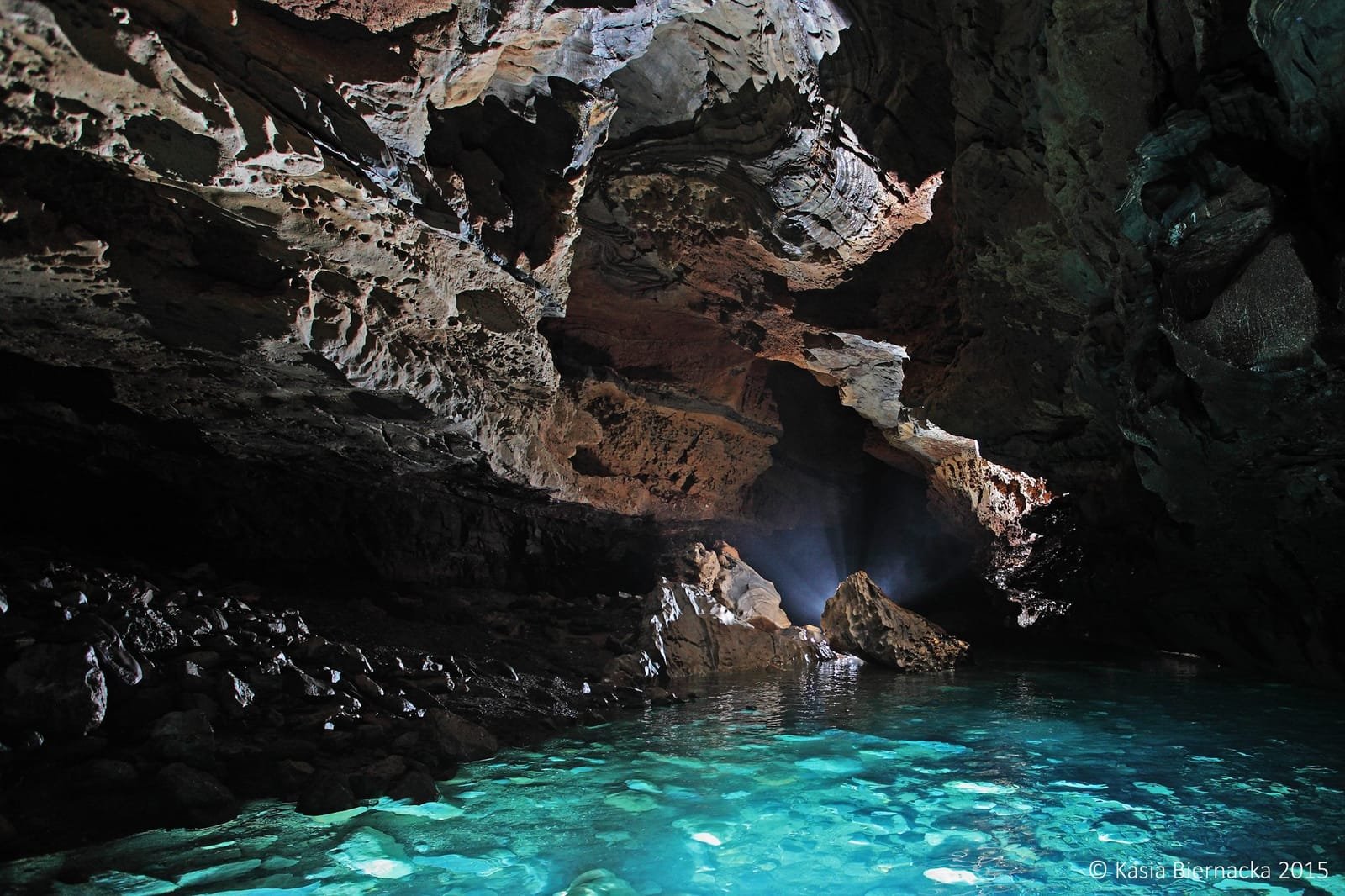
A water chamber in the Sistema Huautla cave system, beneath the Sierra Mazateca. In Mazatec cosmology, caves and springs are living, sacred places. — Photo: Kasia Biernacka · CC BY-SA 4.0 · Source
The people and the landscape
The Sierra Mazateca rises in steep, cloud-wrapped ridges in the north of Oaxaca, above the town of Huautla de Jiménez. To begin a Mazatec mushroom page with the mushroom would be to make the outsider’s mistake. In Mazatec thought the mushrooms belong to a territory: to mountains and caves, to springs and rivers, to the rains that arrive with the summer and the nonhuman powers — the chikon, guardian beings of particular places — who are understood to own the land.1 Coffee grows on these slopes; Catholic saints share the altars; the dead remain present. The mushroom is not a substance lifted out of that world. It is one of its inhabitants.
Mazatec is an Oto-Manguean language, tonal and dialectally various, and that variousness matters for everything that follows: the names, the chants, the very words for the mushrooms shift from community to community.
What they are called
The best-known names are the Spanish niños santos, “holy children,” and the Mazatec ndi xijtho, sometimes glossed “little ones that sprout.” Mazatec is a tonal language that shifts from village to village, so both the names and their spellings change between communities.
Ritual practice: the velada
The velada is a night vigil for healing and divination, led by a curandera or curandero. Recent scholarship describes it in phases — purification and abstinence beforehand, the ceremony itself, and a period of observance afterward.2 The ritual field is built from candles, copal incense, tobacco, flowers, sometimes cacao and aguardiente, and the images of Catholic saints or the Virgin of Guadalupe. The mushrooms are commonly taken in pairs, and the vigil unfolds in darkness or low light so that attention turns inward and toward the healer’s voice.
Preparation is moral and relational more than it is technical. What counts is abstinence, cleanliness, and right conduct in the days before — not a method to be followed.
The songs of the mushroom
In Henry Munn’s classic account, the chanting of a velada is not decoration but the working technology of the rite: the mushroom “speaks” through the healer’s words, naming illness, hidden conflict, truth, and cure.3 María Sabina’s recorded chants — transcribed in Mazatec and translated by Álvaro Estrada — remain the closest thing we have to a first-person testimony of that language from inside the tradition.4 To read them is to understand why “set and setting,” the thin clinical phrase, cannot hold what a velada is.
What the mushroom gives, in the Mazatec telling, is not first of all imagery but speech: a voice that names the illness and the cure. María Sabina described a Book that opened before her, heavy with a wisdom she could suddenly read aloud — “the Language,” given to her and later taken back. Whatever that voice is — a mind meeting itself, the shape a culture presses onto the ineffable, or a person who is simply there — it is the oldest and strangest thing in the record, and the same voice, under other names, reaches peoples the Mazatec never met.
Cosmology
The mushrooms belong to a cosmology, not a pharmacology. They are addressed as persons — children, teachers, sacred interlocutors — and they move within a landscape of caves and hills, rain and earth, saints and the dead, where speech itself can carry power.
Colonialism and exposure
Colonial Christianity condemned Mesoamerican mushroom rites as idolatry, and that pressure never fully lifted. But the decisive modern rupture came in 1957, when Wasson’s Life article carried the velada to a mass audience. What followed — tourism, commodification, intrusive spiritual consumption, and lasting harm to María Sabina herself — is not a footnote to the Mazatec story but part of it. Any honest retelling carries that debt.5
The tradition today
Mazatec mushroom practice survives, but under real pressure: federal prohibition, a globalised psychedelic market, climate stress on the mushrooms, and the steady arrival of outsiders seeking an experience to buy. It is neither a pristine survival from deep time nor a vanished relic. It is a living tradition holding its ground.
Footnotes
-
On chikon and the animate Mazatec landscape, see contemporary ethnography summarised in Fagetti & Mercadillo (2022) and general overviews. ↩
-
Fagetti & Mercadillo, Anthropology of Consciousness (2022). ↩
-
Henry Munn, “The Mushrooms of Language” (1973). ↩
-
Álvaro Estrada, María Sabina: Her Life and Chants (1981). ↩
-
García de Teresa, Journal of Illicit Economies and Development (2022). ↩
The record
Names of the mushroom
| Name | Language | Translation / gloss |
|---|---|---|
| niños santos | Spanish | holy children |
| ndi xijtho † | Mazatec | roughly ‘little ones that sprout’ — one accessible gloss; spellings and forms vary by dialect |
Indigenous- and local-language names appear in many spellings across dialects, publications, and orthographies. We record them as given in our sources and do not standardise them or invent translations. A dagger (†) marks a form our sources flag as uncertain.
Historical record
- Pre-Hispanic
A wider Mesoamerican complex
Sacred mushroom use is attested across Mesoamerica before contact; Mazatec practice belongs to this broader inheritance rather than standing alone.
Historical - 1938–39
Schultes documents Oaxacan use
Richard Evans Schultes records mushroom use among Mazatec, Chinantec, and Zapotec communities, reconnecting the colonial word teonanácatl to living practice.
Living - 1955
Wasson attends a velada
R. Gordon Wasson participates in a night vigil led by María Sabina in Huautla de Jiménez.
Firsthand testimony - 1957
The Life article
Wasson's 'Seeking the Magic Mushroom' brings global attention — and lasting extractive pressure — to the Sierra Mazateca.
Historical - 1971
Prohibition
Psilocybin is placed under international control and Mexican federal law; ceremonial use continues in a tolerated grey zone.
Historical - 2020s
Continuity under pressure
Ethnography documents both survival and commodification: tourism, trade, and climate stress reshape a still-living practice.
Living
Evidence
The support for this entry, separated by kind. Different kinds of evidence carry different weight.
- Firsthand testimony
- María Sabina's recorded chants and life story, transcribed and translated from Mazatec by Álvaro Estrada (1981).
- Contemporary ethnography
- Schultes (1938–40); Wasson & Heim (1950s); recent studies including Fagetti & Mercadillo (2022) and García de Teresa (2022).
- Oral tradition
- Chants, prayers, and diagnostic language transmitted orally across generations.
- Linguistic evidence
- Mazatec-language mushroom names, whose forms vary across dialects and transcriptions and should not be standardised.
What remains uncertain
- The depth of specifically Mazatec (as opposed to broadly Mesoamerican) pre-Hispanic use is not directly documented; claims of unbroken ancient continuity outrun the evidence.
Sources & editorial record
Sources & further reading
Richard Evans Schultes (1940). Teonanácatl: The Narcotic Mushroom of the Aztecs. American Anthropologist / Botanical Museum Leaflets, Harvard.
The paper that reconnected the colonial word teonanácatl to living Oaxacan mushroom use, drawing on Schultes’ 1938–39 fieldwork among Mazatec, Chinantec, and Zapotec communities.
Valentina Pavlovna Wasson & R. Gordon Wasson (1957). Mushrooms, Russia and History. Pantheon Books.
Two-volume study framing the authors’ ethnomycological thesis; includes the 1955 velada account.
R. Gordon Wasson (1957). Seeking the Magic Mushroom. Life Magazine, 13 May 1957.
The mass-market article that exposed the Mazatec velada to a global audience and set the tourism and commodification pressures that followed.
Roger Heim & R. Gordon Wasson (1958). Les champignons hallucinogènes du Mexique. Muséum national d’Histoire naturelle, Paris.
Heim’s mycological identification of the Oaxacan sacred species alongside Wasson’s ethnographic notes.
Henry Munn (1973). The Mushrooms of Language. in M. Harner (ed.), Hallucinogens and Shamanism, Oxford University Press.
Classic argument that Mazatec chant is the working technology of the velada — the mushroom "speaks" through ritual language.
Álvaro Estrada (1981). María Sabina: Her Life and Chants. Ross-Erikson.
Estrada’s Mazatec-language interviews and translation of Sabina’s life story and chants — the closest thing to a first-person testimony.
Antonella Fagetti & Roberto E. Mercadillo (2022). Contemporary Mazatec veladas: ritual structure and healing. Anthropology of Consciousness.
Recent ethnography describing the velada in phases of purification, ceremony, and post-ritual observance.
María García de Teresa (2022). Mushrooms, markets, and the moral economy of Huautla. Journal of Illicit Economies and Development.
On tourism, trade, and the legal-social grey zone around Mazatec mushroom practice today.
Congreso de la Unión (current). Ley General de Salud (arts. 234, 245). Cámara de Diputados, Mexico.
Lists psilocybin and hallucinogenic mushrooms, including Psilocybe mexicana, as controlled substances.
Editorial record
Corrections history
No corrections recorded yet. Spotted an error or a mischaracterisation? See how corrections work.
Last reviewed