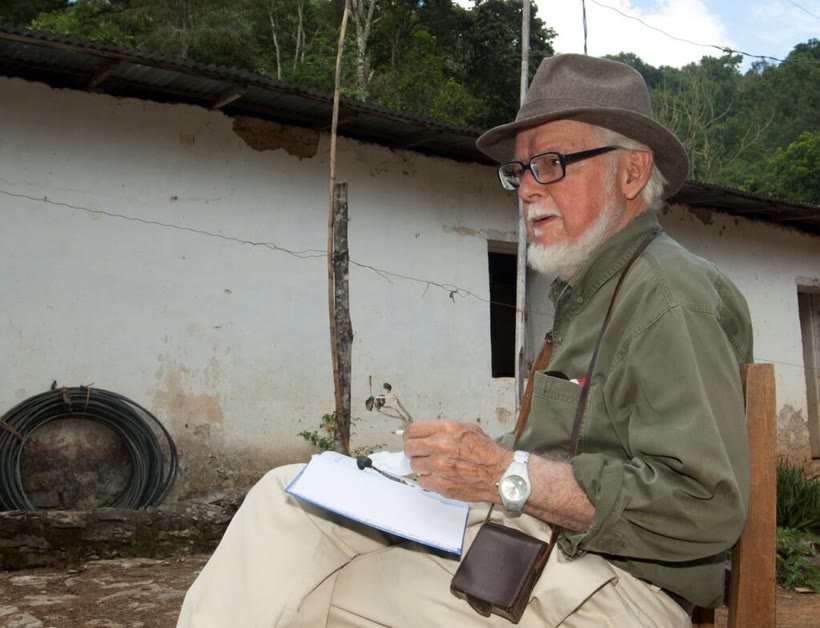
Researcher
Gastón Guzmán
Mexican mycologist · 1932–2016
The Mexican mycologist who described a large share of the world's Psilocybe species and mapped the astonishing diversity of Mexico's sacred mushrooms — and of the peoples who use them.
Cataloguing a hidden diversity
If Schultes reopened the question and Wasson made it famous, Gastón Guzmán did the patient taxonomic labour that turned “the magic mushroom” into a genus of many species. Over a long career he described a substantial fraction of the world’s known Psilocybe, and his monographic work remains a foundation of the field.1
The count of peoples
Guzmán’s most valuable contribution is one of scope. His overviews show that sacred mushroom use in Mexico is not one tradition but many — spread across a range of Indigenous peoples, with distinct species, names, and purposes. It is on the strength of work like his that Mexico can be called the heartland of documented ritual mushroom use, and that the Mazatec, Nahua, Zapotec, Chinantec, and Mixtec are best understood as separate traditions rather than a single blurred picture.
Legacy
Guzmán’s taxonomy underlies much of what is known about these species today. He is a reminder that Mexican scholars, working within Mexico, built the knowledge that outside popular culture later took for its own.
Footnotes
-
Guzmán, “Hallucinogenic Mushrooms in Mexico: An Overview,” Economic Botany (2008). ↩
The record
Sources & editorial record
Sources & further reading
Gastón Guzmán (2008). Hallucinogenic Mushrooms in Mexico: An Overview. Economic Botany 62(3).
Species-level overview; identifies P. caerulescens (Nahua teotlaquilnanácatl) among ceremonially used mushrooms and counts Indigenous peoples with recorded use.
Editorial record
Corrections history
No corrections recorded yet. Spotted an error or a mischaracterisation? See how corrections work.
Last reviewed