Mesoamerica · Culture
Maya
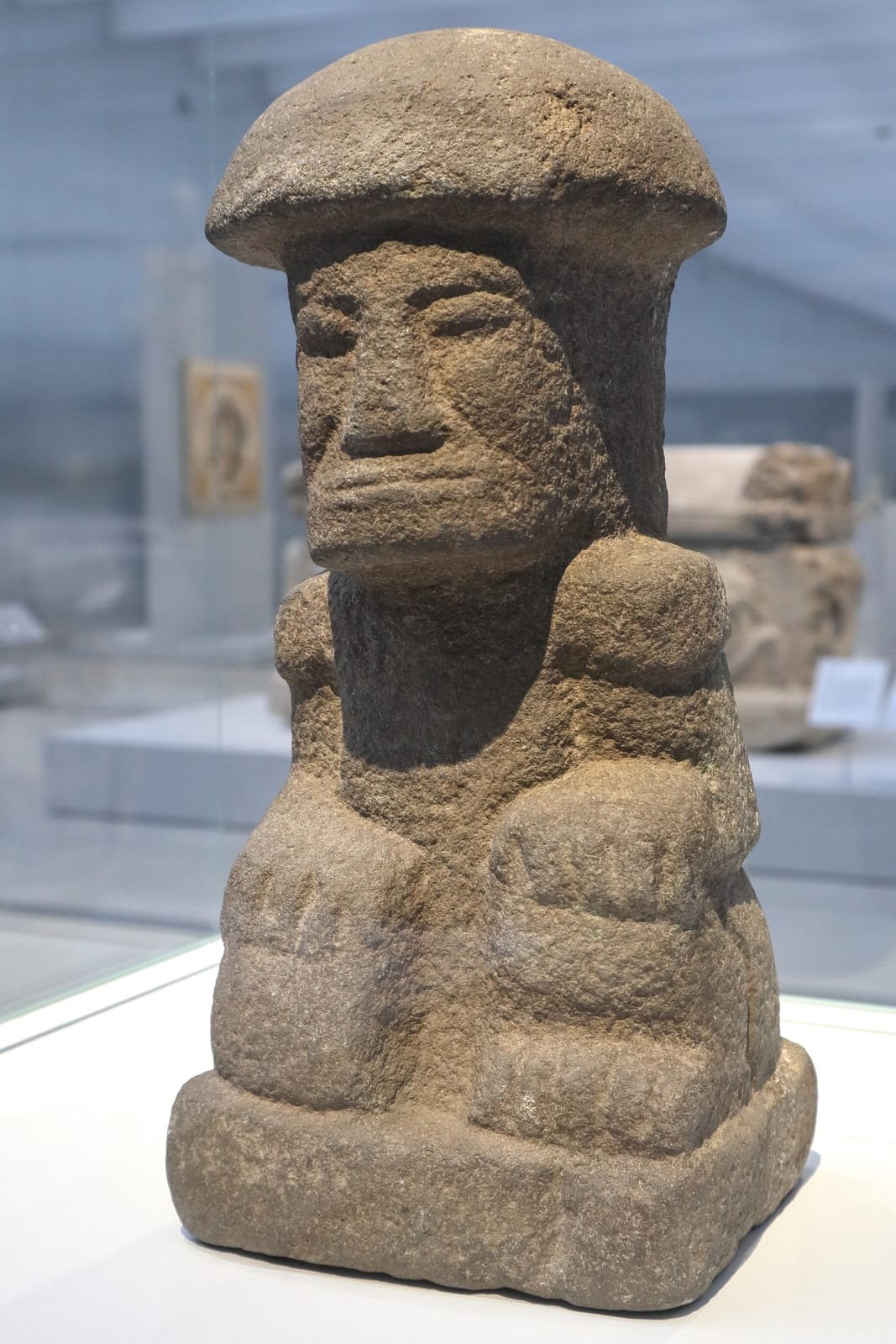
A Maya mushroom stone — a mushroom cap carved over a seated figure in volcanic stone, of the kind at the centre of the debate below. Musée du Quai Branly, Paris. — Photo: JackyM59 · CC BY-SA 4.0 · Source
A powerful story that is not simple
“The Maya” is not one people but a family of peoples and languages spread across Guatemala, southern Mexico, Belize, and Honduras, over millennia. Their possible relationship to sacred mushrooms is one of the most cited in popular psychedelic history — and one of the least settled. What survives is not a filmed ceremony but a field of clues: stones, images, legends, and argument.
What the mushroom stones are
The strongest material evidence is a class of carved objects, often small, shaped like mushrooms, recovered mainly from the southern Maya region and highland Guatemala. In 1961 Stephan de Borhegyi argued that these demonstrated considerable antiquity for a “mushroom-stone cult,” and linked them to underworld powers and the nine lords of the night.1 Later writers extended the entheogenic reading.
The counter-argument
In 1976 Ulrich Köhler challenged the whole interpretation, proposing that at least some mushroom stones were potters’ moulds or anvils — utilitarian tools, not ritual paraphernalia.2 That single reinterpretation is enough to make any confident claim about Classic Maya mushroom ceremonies outrun the evidence. Modern archaeological method adds a further caution: psychoactive fungi rot fast and rarely leave direct traces, so the material record is thin by nature.
Thunder and sacred force
Later highland Guatemalan traditions recorded by Bernard Lowy, in which Quiché speakers identify Amanita muscaria with a word for thunderbolt, are genuinely interesting — they preserve a symbolic grammar of storm, power, and revelation.3 But they belong to a different time and possibly a different mushroom, and they are clues, not proof of ancient psilocybin rite.
An open question
Whether the mushroom stones point to a sacred ritual complex or to something more ordinary is still unresolved. The strongest arguments on each side are set out in full here: Did the ancient Maya use sacred mushrooms?
Footnotes
The record
Historical record
- Preclassic
Mushroom stones appear
Carved stone objects in the shape of mushrooms are made in the southern Maya region, some quite early.
Archaeology - 1961
The 'mushroom-stone cult'
Stephan de Borhegyi argues the stones evidence an ancient mushroom cult, with possible underworld and night-lord associations.
Later scholarly interpretation - 1976
A sharp counter-argument
Ulrich Köhler reinterprets the same objects as potters' moulds or anvils rather than ritual paraphernalia.
Later scholarly interpretation - 1970s
Thunder and Amanita
Bernard Lowy records highland Quiché speakers identifying Amanita muscaria with a word for 'thunderbolt' — symbolic resonance, not proof of Classic Maya psilocybin ritual.
Linguistic evidence
Evidence
The support for this entry, separated by kind. Different kinds of evidence carry different weight.
- Archaeology
- Carved 'mushroom stones' from the southern Maya region — the strongest material evidence.
- Iconography
- Proposed mushroom motifs in Maya art, whose ritual reading is contested.
- Linguistic evidence
- Highland Quiché association of Amanita muscaria with 'thunderbolt' (Lowy).
- Later scholarly interpretation
- Competing scholarly readings — ritual cult (de Borhegyi) versus utilitarian moulds (Köhler).
What remains uncertain
- No directly observed Maya psilocybin ceremony survives; ritual structure, roles, and species are all reconstructed indirectly.
Sources & editorial record
Sources & further reading
Stephan F. de Borhegyi (1961). Miniature Mushroom Stones from Guatemala. American Antiquity 26(4).
Argued that carved mushroom stones evidence an ancient "mushroom-stone cult," linking them to underworld and nine-lords-of-the-night symbolism.
Ulrich Köhler (1976). Mushrooms, Drugs, and Potters: A New Approach to the Function of Precolumbian Mesoamerican Mushroom Stones. American Antiquity 41(2).
The central counterargument: reinterprets mushroom stones as potters’ anvils/moulds rather than ritual paraphernalia.
Bernard Lowy (1974). Amanita muscaria and the Thunderbolt Legend in Guatemala and Mexico. Mycologia 66(1).
Records highland Guatemalan Quiché speakers identifying Amanita muscaria with a word for "thunderbolt" — symbolic resonance, not proof of Classic Maya psilocybin rite.
Congreso de la República de Guatemala (1992). Ley contra la Narcoactividad (Decreto 48-92). Guatemala.
Broadly restricts psychotropics; legal use limited to authorised medical/research contexts.
Editorial record
Corrections history
No corrections recorded yet. Spotted an error or a mischaracterisation? See how corrections work.
Last reviewed