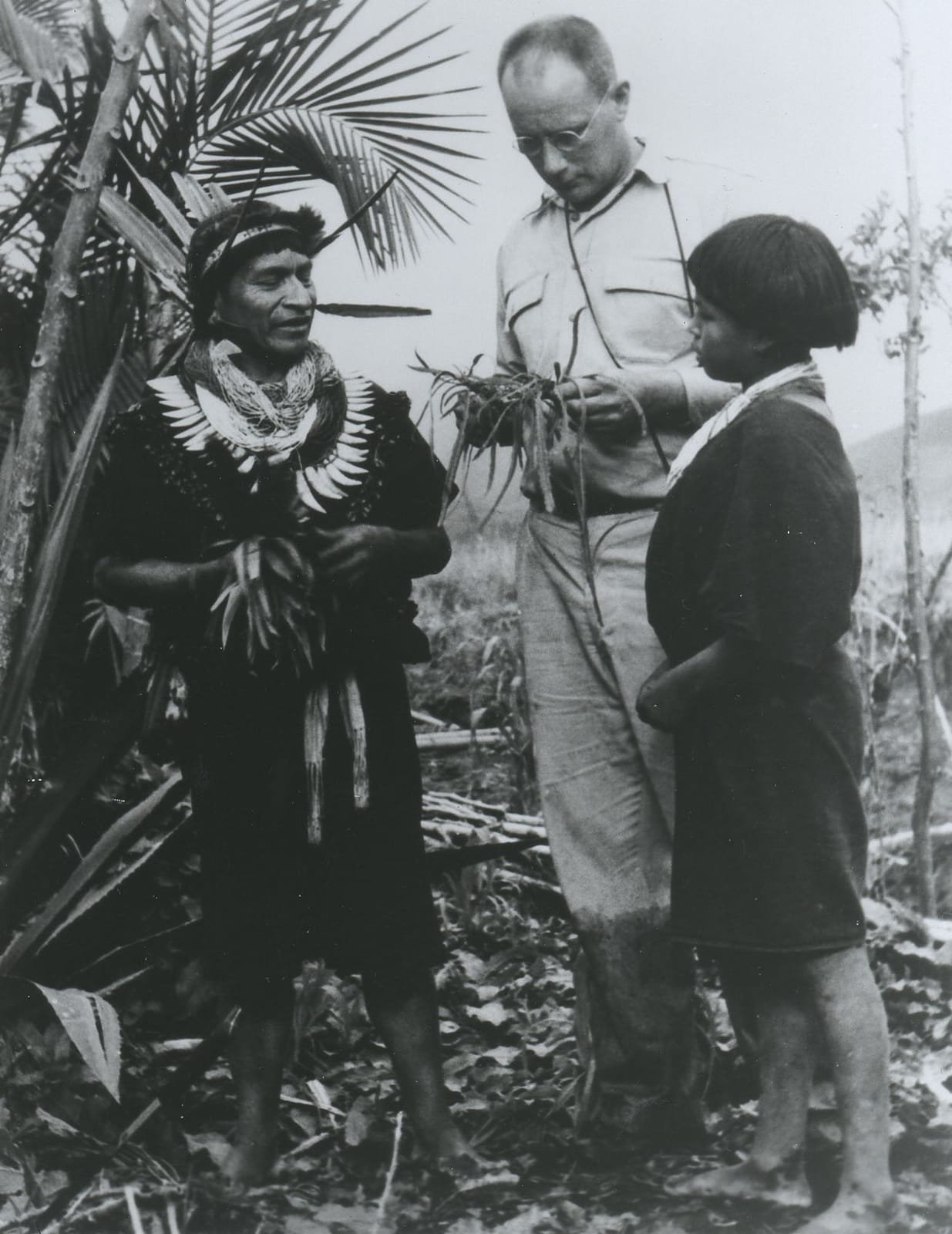
Researcher
Richard Evans Schultes
Harvard ethnobotanist · 1915–2001
The Harvard botanist whose 1938–39 Oaxacan fieldwork reconnected the colonial word teonanácatl to living practice, documenting sacred mushroom use among Mazatec, Chinantec, and Zapotec communities.
The 1938–39 fieldwork
Before Wasson’s fame, there was Schultes’s patience. Working in Oaxaca in 1938–39, the young ethnobotanist documented that the mushrooms colonial writers had called teonanácatl were not a mystery of the past but a living practice among several Oaxacan peoples — Mazatec, Chinantec, and Zapotec.1 His 1940 paper argued the case with botanical care at a time when some scholars still doubted the mushrooms’ identity and effects.
Legacy, and its limits
Schultes went on to become one of the twentieth century’s most influential ethnobotanists. His mushroom work stands out for its method: it took Indigenous knowledge as accurate and worth recording rather than dismissing. It is worth being clear about what he was recording, though — a practice that was never his, kept alive by the Mazatec, Chinantec, and Zapotec long before he arrived and long after he left.
Footnotes
-
Schultes, “Teonanácatl: The Narcotic Mushroom of the Aztecs” (1940). ↩
The record
Sources & editorial record
Sources & further reading
Richard Evans Schultes (1940). Teonanácatl: The Narcotic Mushroom of the Aztecs. American Anthropologist / Botanical Museum Leaflets, Harvard.
The paper that reconnected the colonial word teonanácatl to living Oaxacan mushroom use, drawing on Schultes’ 1938–39 fieldwork among Mazatec, Chinantec, and Zapotec communities.
Editorial record
Corrections history
No corrections recorded yet. Spotted an error or a mischaracterisation? See how corrections work.
Last reviewed