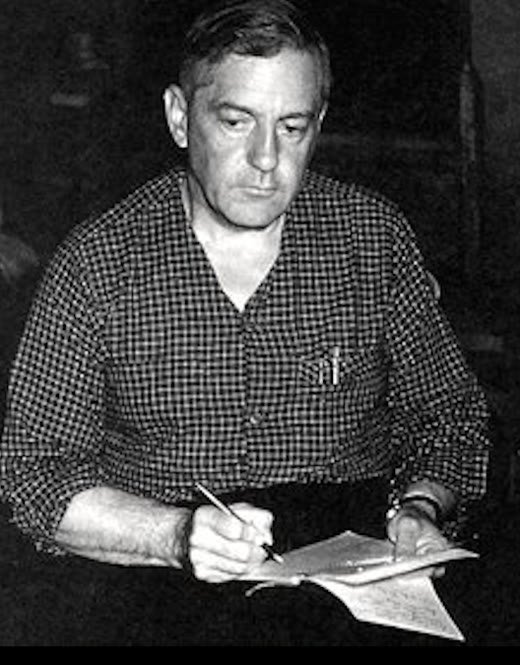
Researcher
R. Gordon Wasson
Banker and amateur ethnomycologist · 1898–1986
The American banker whose 1957 Life article introduced the Mazatec velada to the world — opening a field of study and, at the same time, a wound of exposure and extraction.
It permits you to see, more clearly than our perishing mortal eye can see, vistas beyond the horizons of this life.
Who he was
A vice-president of J.P. Morgan by profession, R. Gordon Wasson pursued mushrooms as a lifelong avocation, coining with his wife Valentina the terms mycophilic and mycophobic for cultures that love or fear fungi. Their two-volume Mushrooms, Russia and History (1957) laid out an ethnomycological thesis that would shape the field.1
”Seeking the Magic Mushroom”
In 1955 Wasson attended a velada led by María Sabina; in May 1957 he published “Seeking the Magic Mushroom” in Life.2 The article is the single most consequential act in the modern history of sacred mushrooms. It created a global fascination, seeded academic study, and drew scientists, seekers, and tourists to the Sierra Mazateca.
What he set in motion
That same article set in motion real harm: the commodification of a healing tradition, the intrusion on María Sabina’s life, and the template for a psychedelic tourism that still strains Oaxacan communities.3 Wasson was neither villain nor hero — he was the figure through whom exposure, with all its benefits and costs, arrived.
Soma, and the limits of a good idea
Wasson later argued, in Soma: Divine Mushroom of Immortality (1968), that the Vedic Soma was Amanita muscaria.4 It is a landmark of speculative ethnomycology and a cautionary one: influential, beautifully argued, and still disputed. See Was Soma the fly agaric?
Footnotes
The record
Cautions
- Wasson's later thesis identifying the Vedic Soma with Amanita muscaria is influential but disputed.
- His legacy is genuinely double-edged and should not be told as simple heroic discovery.
Sources & editorial record
Sources & further reading
R. Gordon Wasson (1957). Seeking the Magic Mushroom. Life Magazine, 13 May 1957.
The mass-market article that exposed the Mazatec velada to a global audience and set the tourism and commodification pressures that followed.
Valentina Pavlovna Wasson & R. Gordon Wasson (1957). Mushrooms, Russia and History. Pantheon Books.
Two-volume study framing the authors’ ethnomycological thesis; includes the 1955 velada account.
R. Gordon Wasson (1968). Soma: Divine Mushroom of Immortality. Harcourt Brace Jovanovich.
The influential (and contested) argument identifying the Rigvedic Soma with Amanita muscaria.
María García de Teresa (2022). Mushrooms, markets, and the moral economy of Huautla. Journal of Illicit Economies and Development.
On tourism, trade, and the legal-social grey zone around Mazatec mushroom practice today.
Editorial record
Corrections history
No corrections recorded yet. Spotted an error or a mischaracterisation? See how corrections work.
Last reviewed