Mesoamerica · Culture
Chinantec
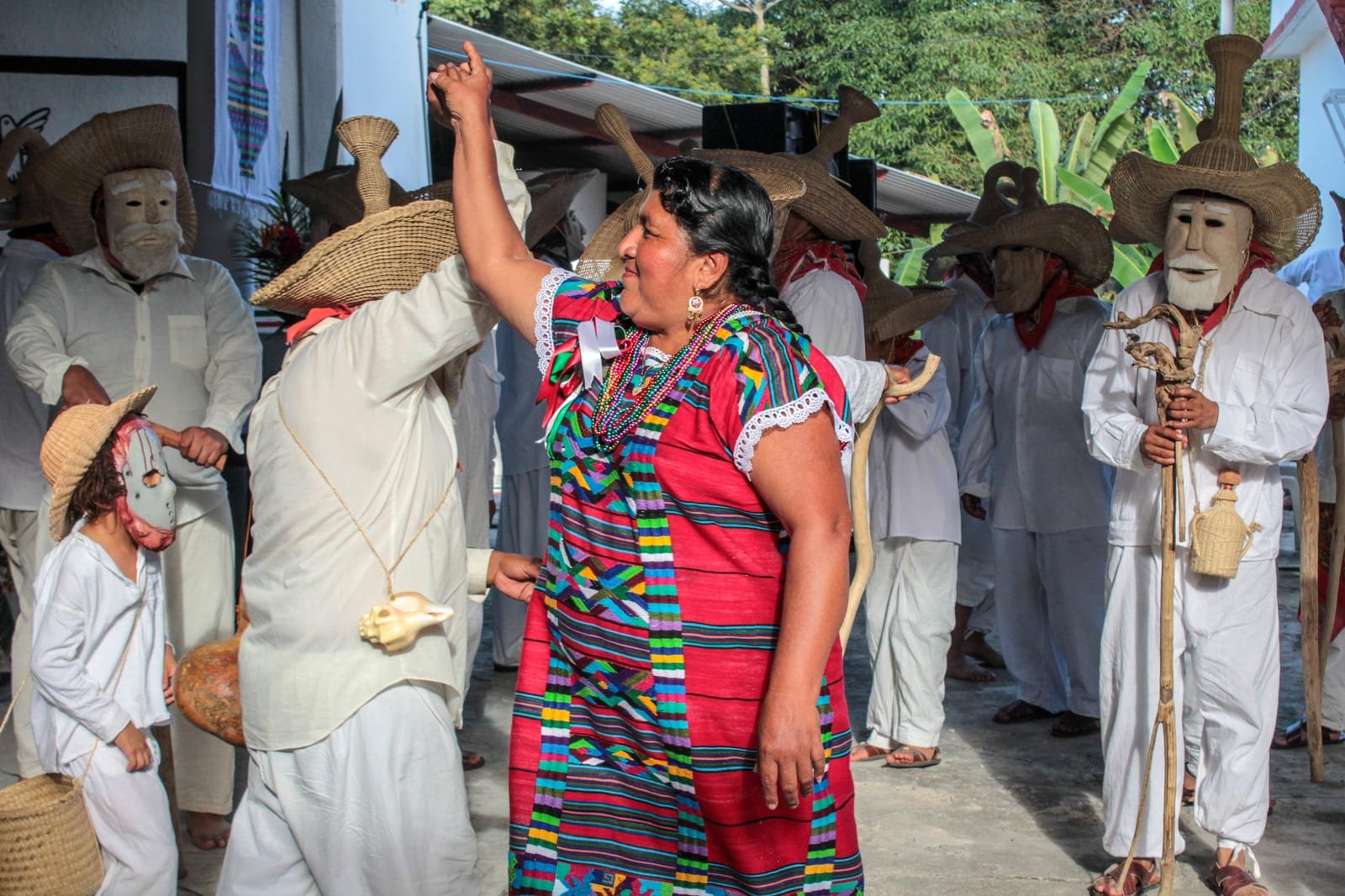
Day of the Dead at Ojitlán, in the Chinantla — masked huehuentones and a woman in traditional dress. The huehuentón tradition is shared across the peoples of the Sierra Norte. — Photo: Fabricio González Soriano · CC BY-SA 4.0 · Source
The people and the landscape
The Chinantec inhabit the Chinantla, a rugged, rain-soaked region of northern Oaxaca neighbouring the Mazatec and Zapotec worlds. Their mushroom record is less famous than the Mazatec one, and that relative quiet is part of its value: it has not been overwritten by decades of tourism and mythology.
Mushrooms for diagnosis
The anchor is Arthur Rubel and Jean Gettelfinger-Krejci’s 1976 study, which describes hallucinogenic mushrooms — identified as Psilocybe hoogshagenii — used for diagnosis among highland Chinantec healers.1 The purpose is not spectacle or transcendence but medical inquiry: finding the cause of an illness so it can be treated. Across Indigenous Mexico, mushrooms are often tools of knowledge before they are anything else.
A velada of the Sierra Norte
In Chinantec towns such as Santiago Comaltepec, the mushrooms are taken at night, in a quiet, prayerful session that closely echoes the Mazatec velada one valley over.2 It is the same nocturnal shape the whole Sierra Norte shares — the holy children eaten in darkness, the healer’s voice moving through hours of song and silence toward an answer. The Chinantec version was simply never turned into a spectacle, and so it kept its own rhythm.
Footnotes
The record
Historical record
- 1938–39
Early documentation
Schultes records Chinantec among the Oaxacan peoples using sacred mushrooms.
Historical - 1976
Mushrooms for diagnosis
Rubel & Gettelfinger-Krejci describe the use of mushrooms identified as Psilocybe hoogshagenii for diagnostic purposes among highland Chinantecs.
Living
Evidence
The support for this entry, separated by kind. Different kinds of evidence carry different weight.
- Contemporary ethnography
- Rubel & Gettelfinger-Krejci (1976), a primary ethnographic study of diagnostic use.
- Botanical / mycological
- Species identification as Psilocybe hoogshagenii.
- Firsthand testimony
- Healer testimony recorded in the 1970s fieldwork.
What remains uncertain
- The core ethnography dates from the 1970s; present-day continuity is less fully documented in open literature.
Sources & editorial record
Sources & further reading
Arthur J. Rubel & Jean Gettelfinger-Krejci (1976). The Use of Hallucinogenic Mushrooms for Diagnostic Purposes among Some Highland Chinantecs. Economic Botany 30(3).
Describes diagnostic use of mushrooms identified as Psilocybe hoogshagenii among contemporary Chinantec healers.
Richard Evans Schultes (1940). Teonanácatl: The Narcotic Mushroom of the Aztecs. American Anthropologist / Botanical Museum Leaflets, Harvard.
The paper that reconnected the colonial word teonanácatl to living Oaxacan mushroom use, drawing on Schultes’ 1938–39 fieldwork among Mazatec, Chinantec, and Zapotec communities.
Gastón Guzmán (2008). Hallucinogenic Mushrooms in Mexico: An Overview. Economic Botany 62(3).
Species-level overview; identifies P. caerulescens (Nahua teotlaquilnanácatl) among ceremonially used mushrooms and counts Indigenous peoples with recorded use.
Congreso de la Unión (current). Ley General de Salud (arts. 234, 245). Cámara de Diputados, Mexico.
Lists psilocybin and hallucinogenic mushrooms, including Psilocybe mexicana, as controlled substances.
Editorial record
Corrections history
No corrections recorded yet. Spotted an error or a mischaracterisation? See how corrections work.
Last reviewed