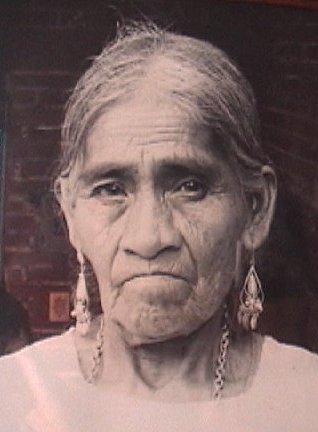
Community practitioner
María Sabina
Mazatec curandera and chjota chjine — ‘one who knows’ · c. 1894–1985
The Mazatec healer whose veladas and sacred chants became known worldwide after 1955 — and who bore much of the cost of that exposure. She is remembered here as a person and a practitioner, not as a symbol standing in for an entire people.
From the moment the foreigners arrived, the sacred mushrooms lost their purity. They lost their force; they spoiled.
Who she was
María Sabina was a chjota chjine — in Mazatec, roughly “one who knows” — a healer of the Sierra Mazateca who worked with the sacred mushrooms in the night vigil called the velada. Her chants, recorded and later transcribed and translated from Mazatec by Álvaro Estrada, are among the most important first-person documents of any living mushroom tradition.1
The velada of 1955, and after
In 1955 she allowed the American R. Gordon Wasson to take part in a velada. It is essential to state plainly what that was and was not: a decision by one healer, in one place, under particular pressures — not a gift of the tradition to the outside world. Wasson’s 1957 Life article made her internationally famous, and the consequences were severe. Tourists and seekers descended on Huautla; accounts describe her losing standing in her own community, her home affected, her later years marked by hardship.2 Her fame and her suffering came from the same event.
The chants
Estrada’s transcriptions show why “drug experience” is far too small a phrase for what she did. In the velada the mushrooms speak through the healer’s language; the chant names illness, truth, and cure. To read her words is to encounter a working sacred technology, not a performance.
How to remember her
Two things are true of María Sabina at once: she was a figure of real and singular importance, and she was not a symbol for an entire people. She was one Mazatec curandera, named María Sabina — which is enough, and a great deal.
Footnotes
The record
Life & work
- c. 1894
Born in the Sierra Mazateca
Born near Huautla de Jiménez; the year is traditionally given as approximate.
- 1955
The velada Wasson attended
She permitted R. Gordon Wasson to take part in a night vigil — a decision made in a specific context, not a grant of the tradition to the world.
- 1957
Global exposure
Wasson's account carried her ceremony to a mass audience, and her name became famous far beyond Oaxaca.
- after 1957
The cost
Tourism and intrusion followed; accounts describe social rupture, loss of standing, and hardship in her later life.
- 1985
Death
She died in the Sierra Mazateca.
Cautions
- Her birth year is given as approximate in the sources.
- She should not be made to represent all Mazatec people, all curanderas, or 'the' mushroom tradition; she was one specialist in a diverse world.
Sources & editorial record
Sources & further reading
Álvaro Estrada (1981). María Sabina: Her Life and Chants. Ross-Erikson.
Estrada’s Mazatec-language interviews and translation of Sabina’s life story and chants — the closest thing to a first-person testimony.
R. Gordon Wasson (1957). Seeking the Magic Mushroom. Life Magazine, 13 May 1957.
The mass-market article that exposed the Mazatec velada to a global audience and set the tourism and commodification pressures that followed.
Valentina Pavlovna Wasson & R. Gordon Wasson (1957). Mushrooms, Russia and History. Pantheon Books.
Two-volume study framing the authors’ ethnomycological thesis; includes the 1955 velada account.
María García de Teresa (2022). Mushrooms, markets, and the moral economy of Huautla. Journal of Illicit Economies and Development.
On tourism, trade, and the legal-social grey zone around Mazatec mushroom practice today.
Henry Munn (1973). The Mushrooms of Language. in M. Harner (ed.), Hallucinogens and Shamanism, Oxford University Press.
Classic argument that Mazatec chant is the working technology of the velada — the mushroom "speaks" through ritual language.
Editorial record
Corrections history
No corrections recorded yet. Spotted an error or a mischaracterisation? See how corrections work.
Last reviewed