Psilocybin · Species
Psilocybe zapotecorum
R. Heim, 1958 · Hongo Santo, Hongo Borracho
A robust Oaxacan species documented in 2025 as the 'holy mushroom' of a Zapotec community — Ni'to be'ya — used for healing and divination before the altar of San Miguel Arcángel.
Identification, in outline
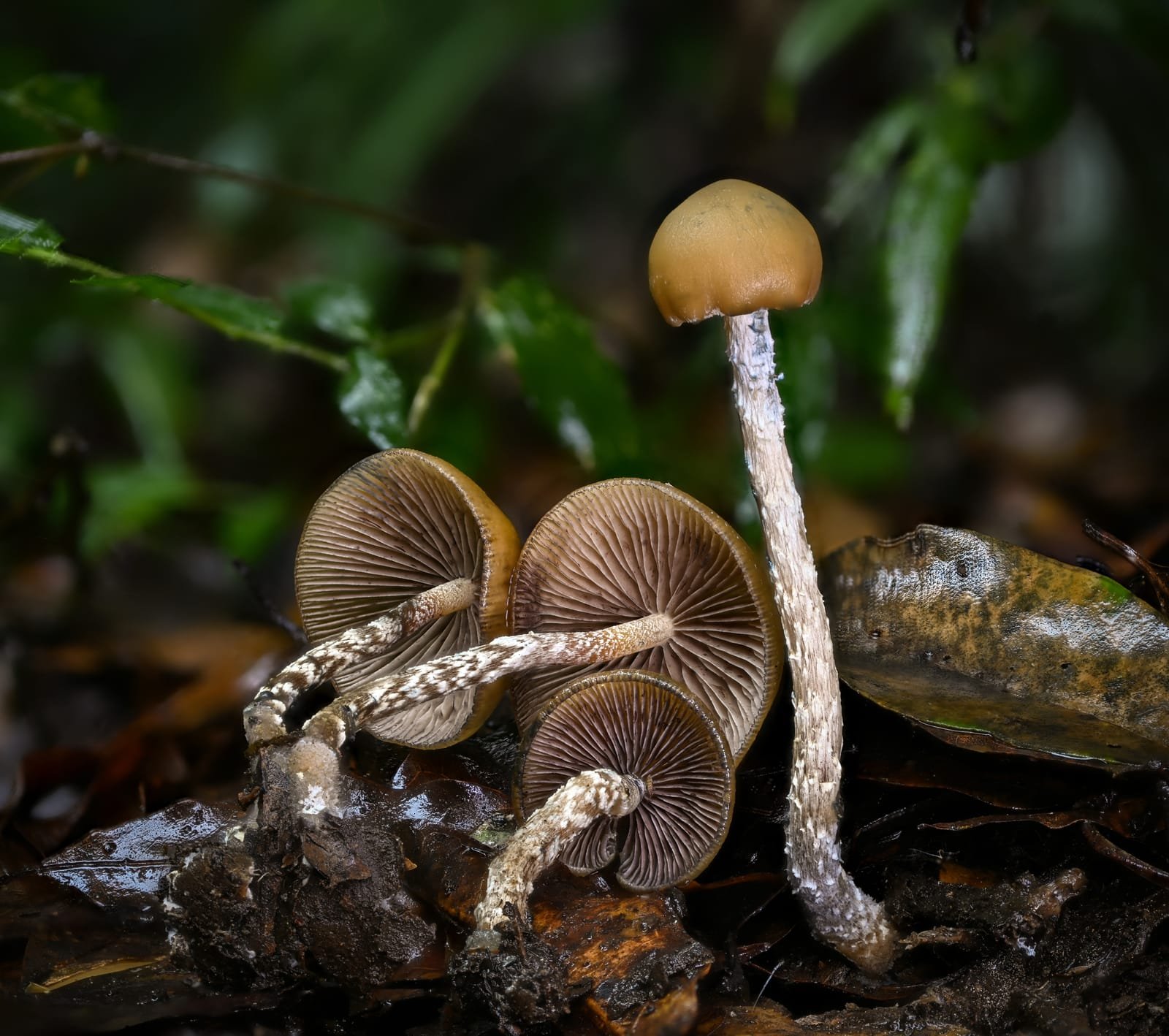
A comparatively large and fleshy Psilocybe, staining deep blue-black where handled, found in the damp, shaded places its Oaxacan habitats provide. A descriptive record only; no gathering guidance is given.
Ecology and habitat
The species favours moisture: seeps, stream banks, and mossy ravine floors. Community members interviewed in 2025 associated its growing scarcity with changing rainfall — a recurring theme across highland Mexican mushroom traditions.1
Cultural associations
A 2025 ethnographic study from El Peral, in San Antonino El Alto, documented P. zapotecorum in living Zapotec ritual use, called Ni’to be’ya, Hongo Santo, and Hongo Borracho.1 The mushrooms are used for healing and divination; the study’s materials show doses laid on leaves, sold in local markets, and incensed with copal before the altar of San Miguel Arcángel. The article is notable precisely because scholarship has concentrated so heavily on Mazatec territory that documented Zapotec practice had gone comparatively unrecorded.
Active compounds
Psilocybin and psilocin.
Toxicity and safety
Not amatoxic, but easy to misidentify, and controlled under Mexican federal law.
Conservation
The 2025 study reports the practice, and the mushroom, as decreasing, with scarcity linked by interviewees to shifting climate and, indirectly, to outside demand.
Footnotes
The record
Local names
| Name | Language | Translation / gloss |
|---|---|---|
| Ni'to be'ya † | Zapotec (Valles Centrales) | ‘holy mushroom’ (approximate) |
| Ni'to be † | Zapotec | — |
| Hongo Borracho | Spanish | drunken mushroom |
Indigenous- and local-language names appear in many spellings across dialects, publications, and orthographies. We record them as given in our sources and do not standardise them or invent translations. A dagger (†) marks a form our sources flag as uncertain.
What remains uncertain
- Local terminology varies by speaker and community; the spellings and glosses here follow the 2025 study and should not be standardised.
Sources & editorial record
Sources & further reading
A. Sánchez-Ramírez & and colleagues (2025). Ritual use of Psilocybe zapotecorum in a Zapotec community of the Valles Centrales, Oaxaca. IMA Fungus.
Contemporary ethnography from El Peral, San Antonino El Alto — documents Ni’to be’ya / Hongo Santo / Hongo Borracho used for healing and divination, incensed with copal before the altar of San Miguel Arcángel.
Gastón Guzmán (2008). Hallucinogenic Mushrooms in Mexico: An Overview. Economic Botany 62(3).
Species-level overview; identifies P. caerulescens (Nahua teotlaquilnanácatl) among ceremonially used mushrooms and counts Indigenous peoples with recorded use.
Congreso de la Unión (current). Ley General de Salud (arts. 234, 245). Cámara de Diputados, Mexico.
Lists psilocybin and hallucinogenic mushrooms, including Psilocybe mexicana, as controlled substances.
Editorial record
Corrections history
No corrections recorded yet. Spotted an error or a mischaracterisation? See how corrections work.
Last reviewed
A cultural and historical record — not a foraging, cultivation, or consumption guide.