Mesoamerica · Culture
Mixe (Ayöök)
Ayöök
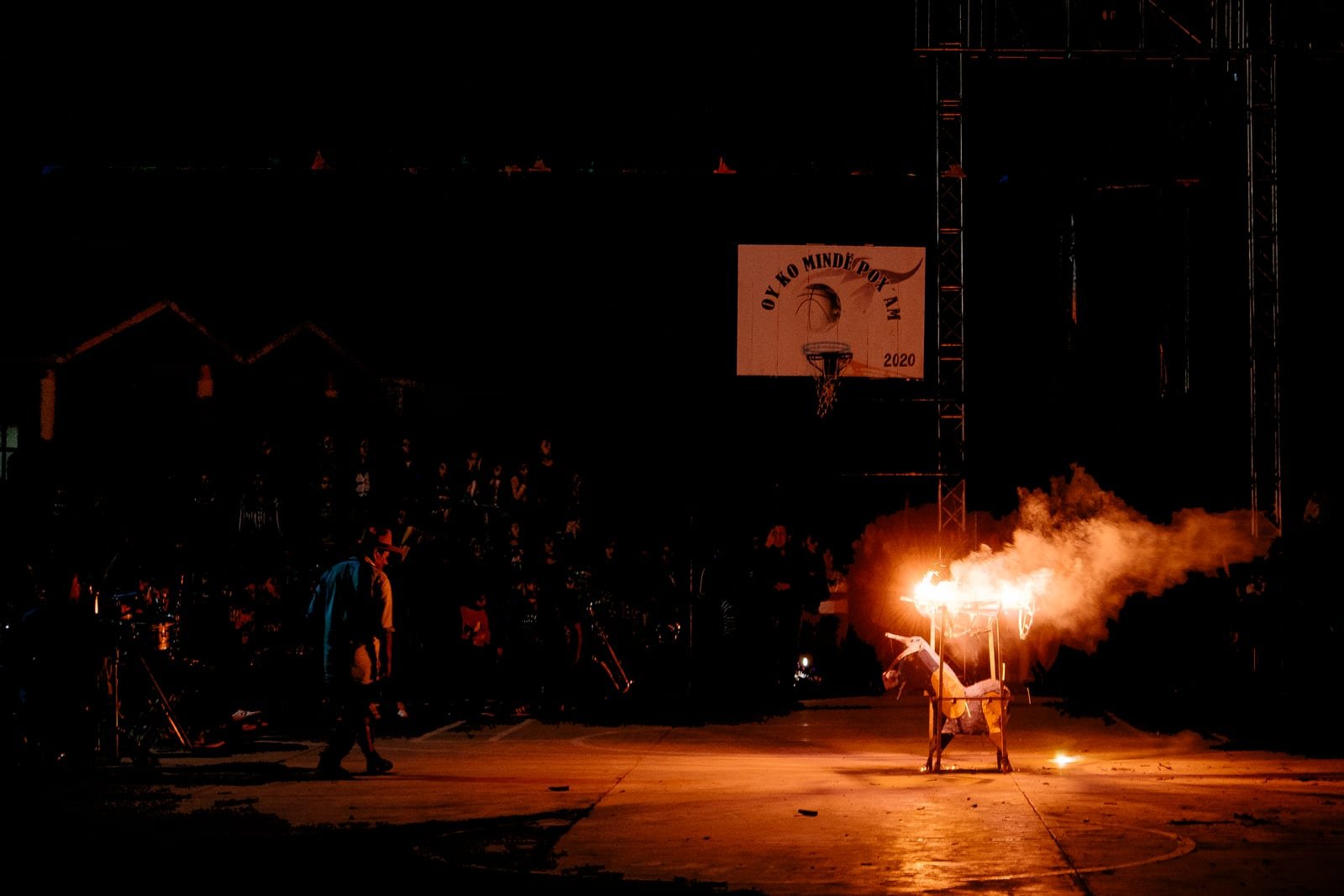
A Mixe (Ayöök) patron-saint festival at San Isidro Huayapam, in the mountains of eastern Oaxaca. — Photo: Jassiel Ramírez · CC BY-SA 3.0 · Source
The people and the mountains
The Mixe — Ayöök in their own language — live in the steep, often fog-bound Sierra Mixe of eastern Oaxaca, a people known for never having been fully conquered, by the Aztecs or, for a long time, by the colonial order around them. That relative independence helped preserve a dense religious life of mountain spirits, calendar priests, and offering-places.
Mushrooms among many medicines
In Frank Lipp’s ethnography of Mixe religion and healing, hallucinogenic mushrooms appear not as a single sacrament but as one tool within a broad ritual pharmacopoeia used for divination, diagnosis, and healing.1 The framing matters: as among the Chinantec, the mushroom here is largely an instrument of knowledge — a way to find the cause of an affliction — set among many other plants and practices.
A less-exposed tradition
The Mixe belong in the record of Mexican mushroom peoples, but with honest limits. The detailed documentation rests heavily on Lipp’s work; the species involved are reconstructed from the wider region; and reliable local names are not in the open sources used here. This is a real tradition — less exposed, and less studied, than its famous Mazatec neighbour.
Footnotes
-
Frank J. Lipp, The Mixe of Oaxaca: Religion, Ritual, and Healing (1991). ↩
The record
Historical record
- 20th c.
Lipp's fieldwork
Frank Lipp documents Mixe religion and healing, including divinatory mushroom use, in a detailed ethnography (published 1991).
Contemporary ethnography
Evidence
The support for this entry, separated by kind. Different kinds of evidence carry different weight.
- Contemporary ethnography
- Frank Lipp, The Mixe of Oaxaca (1991), on Mixe healing and divination.
- Later scholarly interpretation
- Gastón Guzmán's surveys place the Mixe among Mexican peoples with recorded sacred mushroom use.
What remains uncertain
- The open literature on Mixe mushroom use is thinner than for the Mazatec and rests heavily on a single major ethnography.
Sources & editorial record
Sources & further reading
Frank J. Lipp (1991). The Mixe of Oaxaca: Religion, Ritual, and Healing. University of Texas Press.
Ethnography of Mixe (Ayöök) religion and healing, including divinatory use of hallucinogenic mushrooms.
Gastón Guzmán (2008). Hallucinogenic Mushrooms in Mexico: An Overview. Economic Botany 62(3).
Species-level overview; identifies P. caerulescens (Nahua teotlaquilnanácatl) among ceremonially used mushrooms and counts Indigenous peoples with recorded use.
Congreso de la Unión (current). Ley General de Salud (arts. 234, 245). Cámara de Diputados, Mexico.
Lists psilocybin and hallucinogenic mushrooms, including Psilocybe mexicana, as controlled substances.
Editorial record
Corrections history
No corrections recorded yet. Spotted an error or a mischaracterisation? See how corrections work.
Last reviewed