Psilocybin · Species
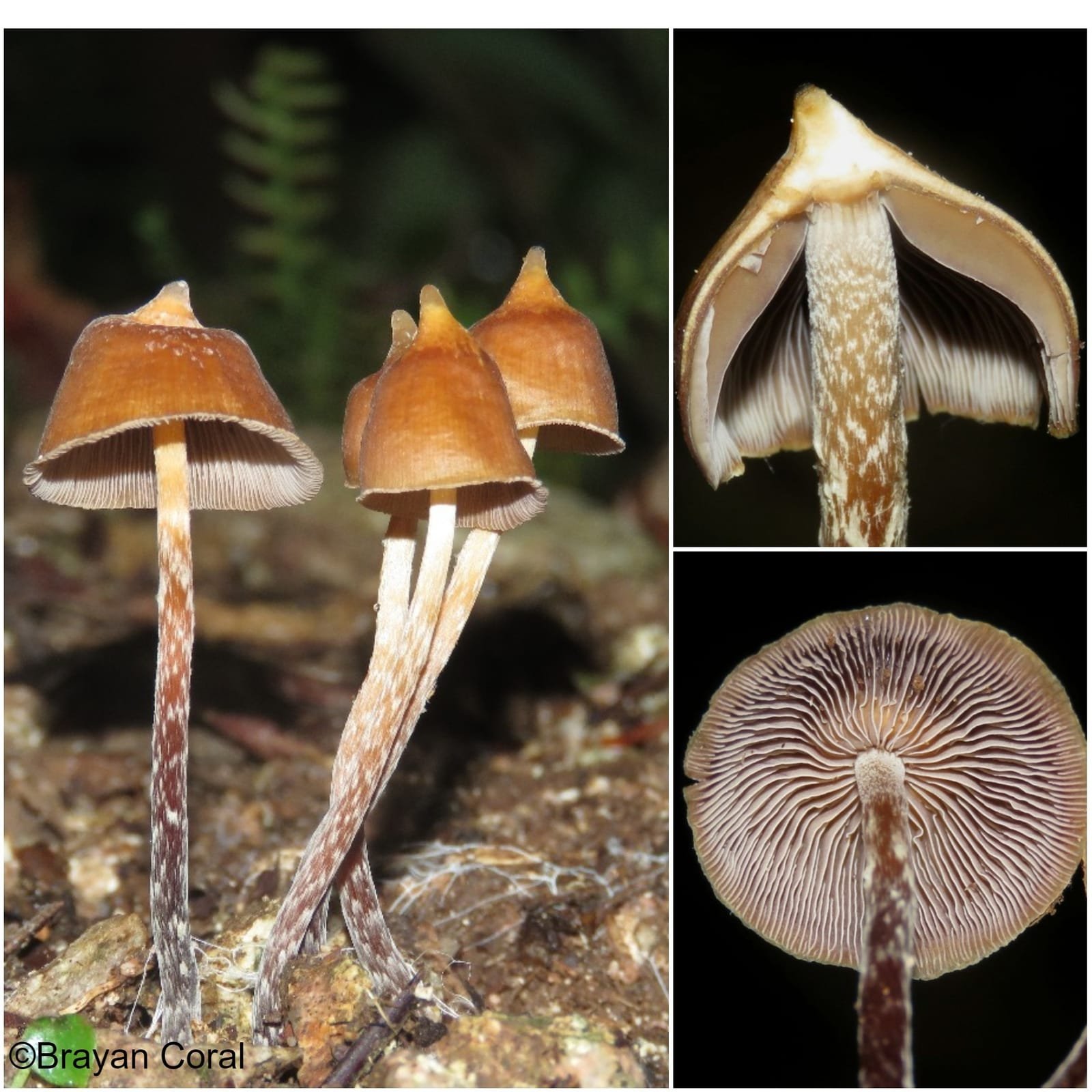
Psilocybe hoogshagenii
Heim, 1959 · Little bird of the divine, pajarito (locally, with other species)
A small Oaxacan mushroom recorded in ethnography as a diagnostic tool among Chinantec — and neighbouring — healers.
Identification, in outline
A small, brown, hood-capped Psilocybe of humid forest floor, often distinguished by a small nipple-like projection at the cap’s apex. Descriptive record only.
Ecology and habitat
The species occurs on rich, damp ground in highland Oaxaca and has been reported more widely across the Neotropics.
Cultural associations
Arthur Rubel and Jean Gettelfinger-Krejci’s 1976 study describes the use of hallucinogenic mushrooms identified as P. hoogshagenii for diagnosis among highland Chinantec healers.1 The Chinantec case is one of the quieter, less-sensationalised records in the Mexican corpus, and a good example of mushroom use whose purpose is medical inquiry — finding the cause of an affliction — rather than spectacle.
Active compounds
Psilocybin and psilocin.
Toxicity and safety
Not amatoxic, but easily confused with dangerous lookalikes, and controlled under Mexican federal law.
Footnotes
-
Rubel & Gettelfinger-Krejci, “The Use of Hallucinogenic Mushrooms for Diagnostic Purposes among Some Highland Chinantecs,” Economic Botany (1976). ↩
The record
What remains uncertain
- Rubel & Gettelfinger-Krejci's fieldwork dates from the 1970s; the *present-day* continuity of Chinantec diagnostic use is less fully documented in open literature.
Sources & editorial record
Sources & further reading
Arthur J. Rubel & Jean Gettelfinger-Krejci (1976). The Use of Hallucinogenic Mushrooms for Diagnostic Purposes among Some Highland Chinantecs. Economic Botany 30(3).
Describes diagnostic use of mushrooms identified as Psilocybe hoogshagenii among contemporary Chinantec healers.
Gastón Guzmán (2008). Hallucinogenic Mushrooms in Mexico: An Overview. Economic Botany 62(3).
Species-level overview; identifies P. caerulescens (Nahua teotlaquilnanácatl) among ceremonially used mushrooms and counts Indigenous peoples with recorded use.
Congreso de la Unión (current). Ley General de Salud (arts. 234, 245). Cámara de Diputados, Mexico.
Lists psilocybin and hallucinogenic mushrooms, including Psilocybe mexicana, as controlled substances.
Editorial record
Corrections history
No corrections recorded yet. Spotted an error or a mischaracterisation? See how corrections work.
Last reviewed
A cultural and historical record — not a foraging, cultivation, or consumption guide.