Essay ·
Teonanácatl: ‘flesh of the gods’?
The word behind the whole Mesoamerican story — what teonanácatl named, and why its famous translation is a scholarly choice rather than a settled fact.
By MushroomTribes editorial
A word, not a species
Almost every account of Mesoamerican mushrooms begins with a single Nahuatl word: teonanácatl. It is worth slowing down on it, because how the word is handled is a good test of whether a source is careful or careless.
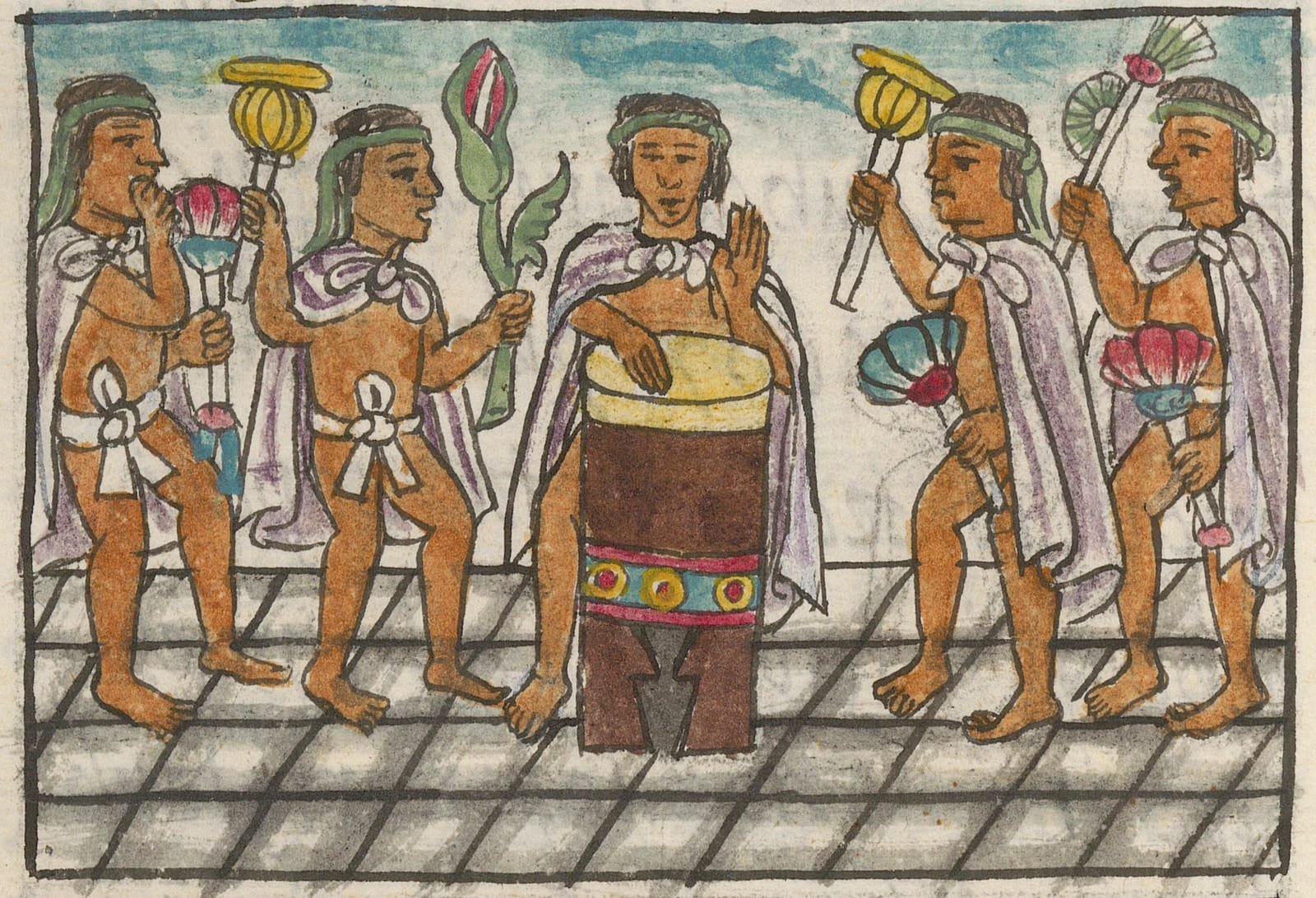
The term combines teotl — god, sacred, divine — with nanácatl, mushroom. It appears in colonial sources, most importantly the Florentine Codex, the sixteenth-century encyclopedia compiled by Bernardino de Sahagún with Nahua collaborators, where mushrooms intoxicate banquet guests and bring visions.1 What the word does not do is name a botanical species. It names a kind of thing — sacred mushrooms — the way “communion wine” names a role, not a grape.
”Flesh of the gods” — a translation, not a fact
The famous rendering “flesh of the gods” is elegant and old, and it may well be right. But it is a translation choice, not a settled fact. Nahuatl compounds can be read more than one way, and other glosses — “sacred mushroom,” “marvellous mushroom,” “divine mushroom” — are all defensible. The phrase is best read as an interpretation rather than the mushroom’s proven literal name.
From word to genus
When Richard Evans Schultes reconnected the colonial teonanácatl to living Oaxacan practice in 1938–39,2 and Gastón Guzmán later mapped the many Psilocybe species involved,3 a single word opened into a whole field. One Indigenous term can hold many species, many peoples, and many purposes; flatten it into “the Aztec magic mushroom” and most of the truth is already gone.
Footnotes
The record
What remains uncertain
- The literal meaning of teonanácatl is debated; 'flesh of the gods' is a translation choice with a long history, not a proven gloss.
- The word names a category of sacred mushrooms, not a single modern species.
Sources & further reading
Bernardino de Sahagún & and Nahua authors of the Colegio de Santa Cruz de Tlatelolco (c. 1577). Florentine Codex (General History of the Things of New Spain), Books 9 & 11. Digital Florentine Codex, Getty Research Institute.
Sixteenth-century Nahua-authored account describing banquet guests eating "little black mushrooms" that intoxicate and bring visions.
Richard Evans Schultes (1940). Teonanácatl: The Narcotic Mushroom of the Aztecs. American Anthropologist / Botanical Museum Leaflets, Harvard.
The paper that reconnected the colonial word teonanácatl to living Oaxacan mushroom use, drawing on Schultes’ 1938–39 fieldwork among Mazatec, Chinantec, and Zapotec communities.
Gastón Guzmán (2008). Hallucinogenic Mushrooms in Mexico: An Overview. Economic Botany 62(3).
Species-level overview; identifies P. caerulescens (Nahua teotlaquilnanácatl) among ceremonially used mushrooms and counts Indigenous peoples with recorded use.
Valentina Pavlovna Wasson & R. Gordon Wasson (1957). Mushrooms, Russia and History. Pantheon Books.
Two-volume study framing the authors’ ethnomycological thesis; includes the 1955 velada account.
Editorial record
Corrections history
No corrections recorded yet. Spotted an error or a mischaracterisation? See how corrections work.
Last reviewed