Documentary report ·
Searching for Soma
The Rigveda opens with a hymn not to a king or a god but to a substance — Soma, a plant pressed for a golden juice that granted visions of the divine, then vanished from history. I spent a season crossing India, from the stone mushrooms of Kerala to the tantric temples of Odisha, chasing the old theory that Soma was a psychedelic mushroom. This is what I found — and what I didn't.
By Dakota Wint
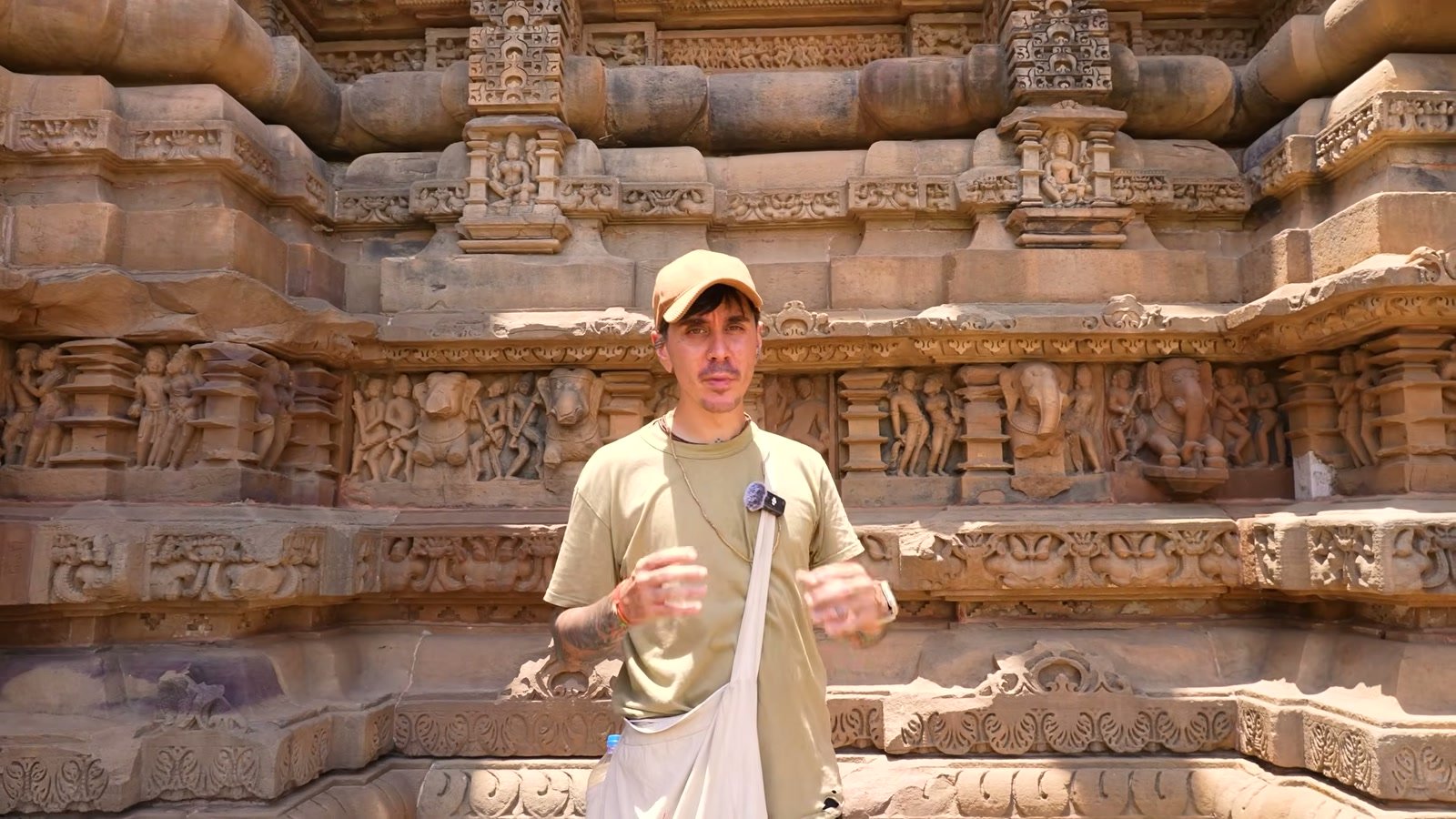
The oldest living scripture in the world opens with a prayer — not to a king, not to a god, but to a mysterious substance said to grant visions of the divine and to unlock the secret world of the gods. They called it Soma, the elixir of immortality. A plant crushed between stones, strained bright and golden through wool, and drunk by priests who then sang: “We have drunk Soma, we have become immortal, we have found the gods.” And then, somewhere across the long life of Hinduism, Soma disappeared. No instructions. No trace. Only the stories, and the echo of a name.
This is a cultural and historical record of a theory — the hunt for what Soma was — not a guide to using any plant or mushroom.
How a mushroom sent me to India
I know it sounds crazy, but a mushroom changed my life. I remember seeing my own breath pulsating as light, and in that moment I understood — not as an idea but as a fact — that the entire universe is alive. It was an awakening, and it set the direction of everything after.
I went to Mexico to learn how whole cultures had built themselves around that experience. Then to Maui, where Ram Dass guided me. But it was a monk in California who handed me the thing that pulled it all together: the Bhagavad Gita. The teachings in that book mirrored what the mushroom had shown me — a hidden unity behind the separations of life. The book is thousands of years old. How did they know? I had a hunch that Hinduism itself had a psychedelic origin. So I went to India to find out.
The clue on a bench
I stayed weeks at the temple at Kainchi Dham, met holy men, learned to meditate — and kept turning up the same strange figure: Soma, an unidentified plant spoken of like a god. Pressed with stones, filtered through wool, bright and golden. We have taken it; we have become immortal. I asked everyone. Nobody knew anything.
Then, visiting the giant Adiyogi statue in Tamil Nadu, I noticed a man on a bench reading a book — a big red mushroom on the cover, and the title SOMA, by R. Gordon Wasson. It felt like waking out of the matrix. Wasson’s theory was that Soma was a mushroom — specifically the fly agaric, Amanita muscaria — because in the Rigveda the Soma “plant” has no seeds, no leaves, no roots, and is prepared exactly the way Mexican shamans prepare their mushrooms. (The full case, for and against, lives in the Soma debate.)
The stone mushrooms of Kerala
If Soma was a mushroom, I reasoned, there would be something — a carving, a memory. Everything I read said there was nothing to find. And then I found something: massive stone mushrooms, deep in the jungles of Kerala, only a few hours from where I was standing. Roughly 3,000 years old — about when the Rigveda was composed. Archaeologists read them as ancient burial markers. Maybe. But the people who eat mushrooms here point out that the stones are shaped exactly like the mushroom that pushes up out of the earth after the rains.
A local led me to a doctor whose family had lived in these forests for generations as healers — he still kept ancient palm-leaf manuscripts full of the local ecosystem’s knowledge. He’d never heard of Soma. But he knew mushrooms: he counted off nearly ten psychedelic species growing wild in Kerala, Psilocybe and Panaeolus among them. “There are three mushroom stones from 2000 BC,” he said. “So it was part of the culture. We lost it somewhere. And it’s already there — it’s growing naturally.” Carved into stone, but never named in scripture. Something happened in between.
Odisha, and the elixir that hid
The trail led north to Odisha — and to a different religion carrying the same secret. In the tantric Kapalini temple, tucked into an ordinary neighbourhood, I found goddesses on the walls holding what look unmistakably like mushrooms, umbrella caps popping off their stems. Worshippers still leave Datura flowers at the feet of Shiva and the goddess here — a powerful, dangerous visionary plant used by shamans on nearly every continent. When you ask why this flower, nobody has an answer. I think the answer is that it was once known for exactly what it does.
Nearby, at the Buddhist site of Langudi Hills, I walked among unexcavated mounds hiding Vajrayana relics. Vajrayana — the tantric, esoteric school of Buddhism — speaks of an elixir of immortality called Amrita, described almost word for word the way the Rigveda describes Soma: a golden liquid poured in ritual, granting visions, clarity, and immortality. Soma disappears from history. Amrita, maybe, is where it hid.
Shiva, Lord of Soma
This is where the symbolism starts to stack up. Shiva carries the name Someshwara — Lord of Soma. He is Neelkantha, the blue-throated one, who swallowed a poison and transmuted it into something sacred — which is precisely what a shaman does with a toxic plant. Psilocybin mushrooms bruise blue. Shiva rides Nandi, a bull; psilocybin mushrooms grow from the dung of cattle. And in his older form as Rudra, he is described as red, flecked with a thousand white eyes — which Wasson read as a near-perfect portrait of the fly agaric.
Then there’s the language. The Sanskrit word chhatra means “umbrella” — but it is also a common word for mushroom, and chhatraka literally means fungus. Once you know that, the umbrellas carved over gods and stupas stop looking like parasols.
The 64 Yoginis and the one-footed god
A recurring thread — the moon — led me to the Chausath Yogini temple: a circle of sixty-four stone goddesses, open to the sky, roofless so the moonlight falls straight in. Above many of their heads sit shapes that read, once you’re looking, like caps of mushrooms. These yoginis were keepers of plant knowledge and healing power, driven into secrecy and finally erased as “witches.”
Inside, a caretaker showed me a carving of Aja Ekapada — “the unborn, one-footed one,” an early name of Shiva that appears in the Rigveda right alongside Soma. It is tied to rain and storms, and depicted as a single pillar. A mushroom springs from invisible spores — unborn — rising as a single stalk after the rain, and is called, like Soma, a bull. The Buddhist teacher Lama Mike Crowley reads Aja Ekapada as a hidden cipher for the mushroom itself: one leg, the moon on its head.
Chhatrapur — “the place of the mushroom”
Late one night, deep in research, I found a journal translating a place-name — Chhatrapur — as place of the mushroom. I’d come too far to ignore it. It led me to Khajuraho, the great temple complex famous for its encoded, layered symbolism, whose old name even traces back to Drona — the Rigveda’s word for the vessel that holds Soma.
At the foot of nearly every temple there sat a small altar I’d never seen anywhere else in India: one large mushroom ringed by smaller ones, carved in stone, with goddesses looking down at it, and lines of Datura flowers leading the eye straight to the deities above. Outside one shrine stood Nandi the bull, staring directly at the altar. And the locals — casually, without any theory to sell — kept telling me the same thing: chhatra means umbrella, yes, but chhatra also means mushroom.
So — was Soma a mushroom?
Here’s my honest answer, after all of it. As much as I loved chasing this through the temples and texts and sacred landscapes of India, I don’t think there’s enough evidence to say what Soma really was. There were carvings, stories, and theories — but no smoking mushroom. Not proof. Hints.
What I did come away with is smaller and, to me, bigger: these unusual states of awareness are reachable by many paths, and mushrooms are only one of them. But trace the origins of the world’s religions and again and again you arrive at an encounter — with nature, with a plant, with a presence — that people never fully explained. Beneath our ordinary awareness lies a mystery still waiting to be excavated.
The search isn’t over. If you want to pick up the trail where I left it, look at the ancient Zoroastrian haoma — described almost exactly like Soma. That’s a deep rabbit hole for another day. (And a small footnote: before I’d even finished editing the film, Paul Stamets found this journey and included a piece of it in his new book. But that’s a story for another time.)
The mystery continues.
The record
Sources & further reading
dakota of earth (@dakotawint) (2025). Did Ancient Hindu's Use Mushroom? (Searching for Soma). YouTube.
A video documentary by the channel “dakota of earth” revisiting Wasson’s Amanita-as-Soma thesis and the wider hunt for the botanical identity of Soma; an accessible entry point, not a scholarly source.
R. Gordon Wasson (1968). Soma: Divine Mushroom of Immortality. Harcourt Brace Jovanovich.
The influential (and contested) argument identifying the Rigvedic Soma with Amanita muscaria.
Editorial record
Corrections history
No corrections recorded yet. Spotted an error or a mischaracterisation? See how corrections work.
Last reviewed