South Asia · Culture
Vedic (Indo-Iranian)
Ārya
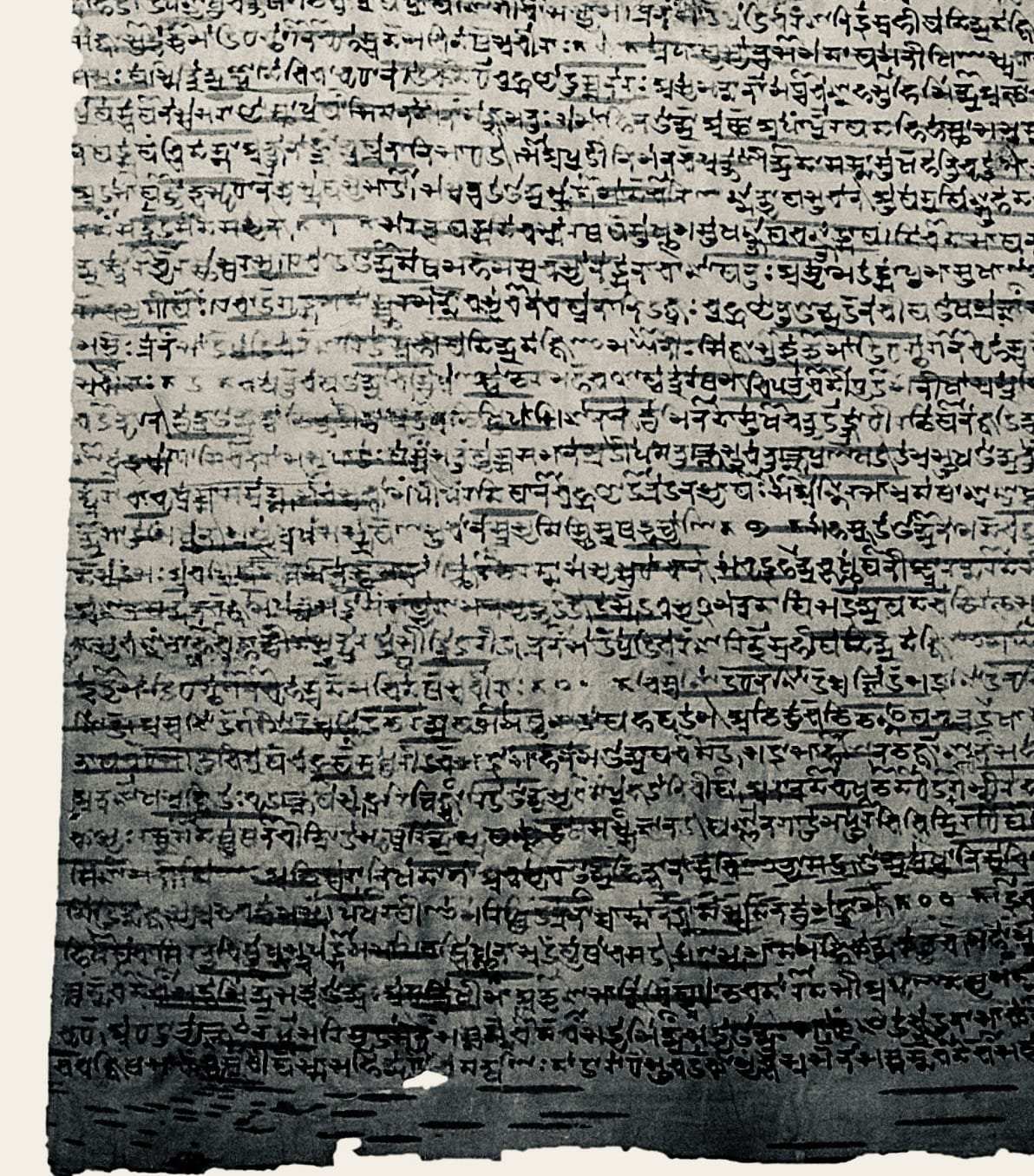
A palm-leaf Rigveda manuscript (Sharada script, Kashmir). The hymns praise Soma at length without ever naming the plant. — Ms Sarah Welch, via Wikimedia Commons · CC0 (public domain) · Source
Soma, the pressed god
The Rigveda — composed in the north-west of the Indian subcontinent perhaps three thousand years ago — praises Soma: a plant pressed for a golden juice, filtered through wool, mixed with milk, and drunk by priests and gods to bring vigour, ecstasy, and inspired vision. Soma is at once the drink, the plant, and a deity. What the plant actually was — which species, which mountain it grew on — the hymns never plainly say, and that knowledge seems to have been fading even as they were composed.
The mushroom theory
In 1968 R. Gordon Wasson argued that Soma was the fly agaric, Amanita muscaria. He pointed to verses that seem to describe a plant with no ordinary leaf, root, or seed, pressed for a radiant juice, and to Siberian parallels of fly-agaric use — including passages he read as pointing to the recycling of urine, a documented feature of that Siberian practice. No common plant, he argued, fit the poems so cleanly.
The case against
The identification never settled. The same hymns have been read as describing Ephedra, Syrian rue (Peganum harmala), and other plants; no Vedic text actually names a mushroom; and there is no material or independent evidence of early Indo-Iranian fly-agaric ritual. A beautiful literary argument, critics note, is not the same as proof.
Where it stands
The identity of Soma remains genuinely open. The full argument, on both sides, is set out in the debate: Was Soma the fly agaric?
Watch: Searching for Soma
A video documentary by dakota of earth, Did Ancient Hindu’s Use Mushroom? (Searching for Soma), walks through the same question for a general audience. It is an accessible introduction rather than a scholarly source — useful for the shape of the debate, not for settling it.
The record
Names of the mushroom
| Name | Language | Translation / gloss |
|---|---|---|
| Soma † | Sanskrit | the deified 'pressed' drink; its botanical identity is unknown |
Indigenous- and local-language names appear in many spellings across dialects, publications, and orthographies. We record them as given in our sources and do not standardise them or invent translations. A dagger (†) marks a form our sources flag as uncertain.
Historical record
- c. 1500–1000 BCE
The Soma hymns
The Rigveda, composed and transmitted orally, devotes an entire book to Soma — plant, drink, and god.
Linguistic evidence - 1968
Wasson's Amanita thesis
R. Gordon Wasson argues that Soma was the fly agaric, Amanita muscaria.
Later scholarly interpretation - late 20th c. onward
Competing candidates
Scholars propose Ephedra, Syrian rue, and others; the question stays open.
Later scholarly interpretation
Evidence
The support for this entry, separated by kind. Different kinds of evidence carry different weight.
- Linguistic evidence
- Rigvedic hymns describe a plant pressed for its juice, seemingly without ordinary leaves or root — but name no species.
- Later scholarly interpretation
- Wasson (1968) matched the imagery to Amanita muscaria; others read it as Ephedra, Peganum harmala, and more.
What remains uncertain
- The identity of Soma is one of the oldest unsolved questions in the study of religion; several candidates remain in play.
Sources & editorial record
Sources & further reading
R. Gordon Wasson (1968). Soma: Divine Mushroom of Immortality. Harcourt Brace Jovanovich.
The influential (and contested) argument identifying the Rigvedic Soma with Amanita muscaria.
Andy Letcher (2006). Shroom: A Cultural History of the Magic Mushroom. Faber & Faber.
A critical cultural history that deflates several popular entheogenic myths — useful precisely where it disagrees with the psychedelic canon.
dakota of earth (@dakotawint) (2025). Did Ancient Hindu's Use Mushroom? (Searching for Soma). YouTube.
A video documentary by the channel “dakota of earth” revisiting Wasson’s Amanita-as-Soma thesis and the wider hunt for the botanical identity of Soma; an accessible entry point, not a scholarly source.
Editorial record
Corrections history
No corrections recorded yet. Spotted an error or a mischaracterisation? See how corrections work.
Last reviewed