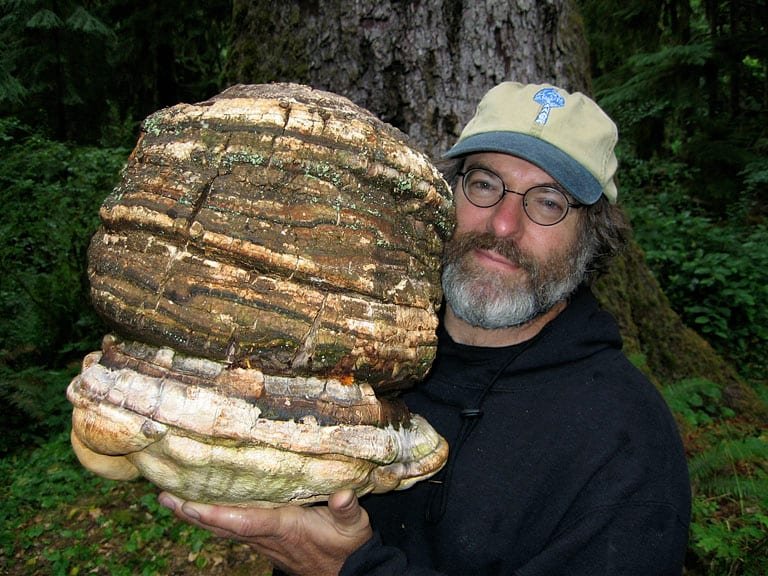
Researcher
Paul Stamets
American mycologist, author & psilocybin advocate · b. 1955
The mycologist who did more than almost anyone to name, illustrate, and popularise the world's psilocybin mushrooms — author of the standard identification guide, describer of species such as Psilocybe azurescens, and a tireless, sometimes controversial advocate for fungi in medicine and ecology.
Why he belongs in the archive
Most of the people in this archive are either community practitioners or the field researchers who documented them. Paul Stamets is a different kind of figure: the person who, more than any other in the late twentieth century, turned scattered knowledge of the psilocybin mushrooms into an organised, illustrated, widely available body of reference. Whatever one makes of his more expansive claims, the taxonomy and identification work is a genuine contribution — and it is why the modern conversation about these species is legible at all.
The field guide and the species
Stamets began writing while still a student, driven partly by a practical concern: bad identification kills people. His 1996 Psilocybin Mushrooms of the World became the standard photographic identification guide to the group.1 He also described or co-described a number of species, and his naming choices are famously personal — Psilocybe azurescens is named for his son Azureus, and Psilocybe weilii for the physician Andrew Weil.
In a fitting turn, a mushroom now carries his name: Psilocybe stametsii, a tiny species from the Los Cedros cloud forest of Ecuador, collected by Bryn Dentinger and Giuliana Furci and announced in 2023 — from the same Utah mycology group now untangling the little-people bolete.2
Advocacy — and where the evidence thins
Beyond taxonomy, Stamets is a prominent advocate for fungi in medicine, ecology (mycoremediation), and the renewed scientific study of psilocybin. Here the archive keeps its usual discipline: some of his ideas — the ecological roles of mycelium, the case for clinical psilocybin research — sit on firmer ground than others, and several popular health claims associated with his name are not yet supported by strong peer-reviewed evidence. He is also an entrepreneur; this page documents his role in the field and endorses none of his products.
A populariser, honestly labelled
Stamets is best understood as a populariser and taxonomist rather than a traditional academic mycologist, and that is not a criticism — popularisation, done carefully, is how identification knowledge reaches the people who need it. The archive records his real contribution while keeping his stronger claims where they belong: interesting, influential, and to be weighed against the evidence.
Footnotes
The record
Sources & editorial record
Sources & further reading
Paul Stamets (1996). Psilocybin Mushrooms of the World: An Identification Guide. Ten Speed Press.
The best-known modern field guide to psilocybin species; widely used for identification and a key vehicle for popularising the group. A reference work, not a peer-reviewed study.
Bryn T. Dentinger et al. (2023). Psilocybe stametsii sp. nov. — a new species from the Los Cedros cloud forest, Ecuador. Fungi Foundation / Natural History Museum of Utah.
Describes a tiny Andean Psilocybe named in Stamets’ honour, collected by Dentinger (2011) and Furci (2022) — the same Utah mycology group behind the Lanmaoa work.
Editorial record
Corrections history
No corrections recorded yet. Spotted an error or a mischaracterisation? See how corrections work.
Last reviewed