Muscimol / ibotenic acid · Species
Amanita muscaria
(L.) Lam., 1783 · Fly agaric, fly amanita
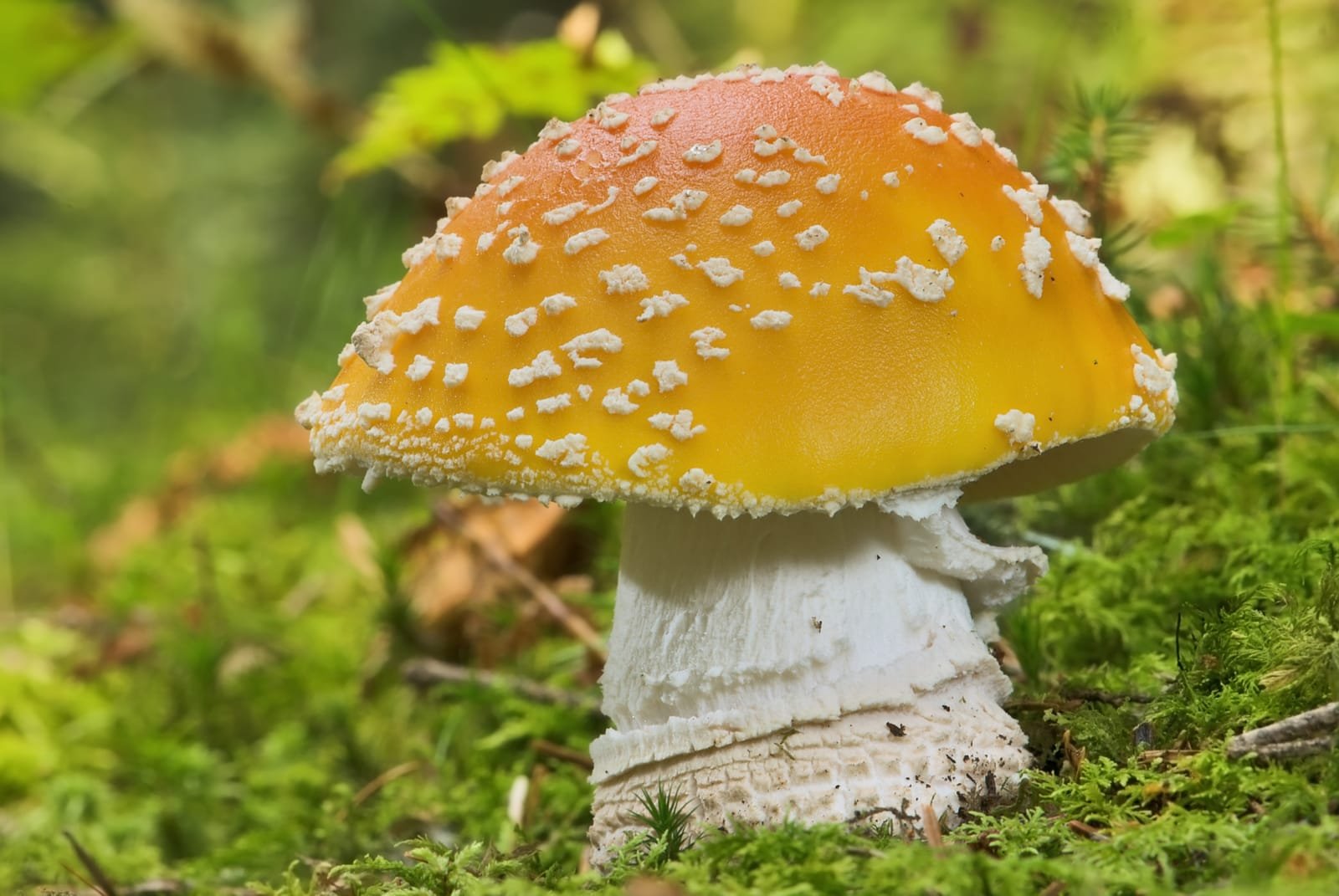
The fly agaric — a genuinely toxic, muscimol-bearing mushroom (not a psilocybin species) at the centre of documented Siberian ritual use and a long train of disputed theories, from Soma to berserkers to Christmas.
A different mushroom entirely
The fly agaric is the archetypal storybook toadstool — scarlet, white-flecked, unmistakable — and it is not a psilocybin mushroom. Its principal active compounds are ibotenic acid and muscimol, which act on a different neurochemical system. It is also genuinely toxic: serious poisonings occur, and it should never be confused with the psilocybin species.
Ecology and habitat
Amanita muscaria is mycorrhizal, living in partnership with the roots of birch, pine, and spruce across the boreal North. Its range tracks those trees, which is part of why its best-documented ritual use belongs to the peoples of the Siberian forest and tundra.
Documented ritual use: the Siberian record
The strongest evidence for ceremonial use comes from the Russian Far East, where classic ethnography — above all Waldemar Jochelson’s early-twentieth-century study of the Koryak — records the fly agaric (wapaq) as an intoxicant with ritual and social significance, surrounded by taboo and specialist practice.1 Related traditions are reported among the Chukchi and other Siberian peoples.
Toxicity and safety
Ibotenic acid is a potent neurotoxin, and raw or careless consumption causes real harm. Siberian ethnography records deliberate processing — for example drying, which converts some ibotenic acid to the less-toxic muscimol — noted here as history, not as a method to follow.
A magnet for theories
More myths cluster around this mushroom than any other. It has been proposed as the Vedic Soma, as the source of Norse berserker fury, and — in a modern folk theory — as the secret behind reindeer, flying, and Father Christmas. Some of these ideas are serious if unproven; others are late inventions. Each is examined, and rated, in Evidence & Debates.
Footnotes
-
Jochelson, The Koryak (Jesup North Pacific Expedition, 1905–1908). ↩
The record
Local names
| Name | Language | Translation / gloss |
|---|---|---|
| wapaq † | Koryak | — |
| mukhomor (мухомор) | Russian | ‘fly killer’ |
Indigenous- and local-language names appear in many spellings across dialects, publications, and orthographies. We record them as given in our sources and do not standardise them or invent translations. A dagger (†) marks a form our sources flag as uncertain.
What remains uncertain
- Most of the popular lore around this mushroom — Soma, Norse berserkers, reindeer, and Santa Claus — is disputed or speculative, not established history.
Sources & editorial record
Sources & further reading
Waldemar Jochelson (1905–1908). The Koryak. Jesup North Pacific Expedition, Vol. VI, AMNH.
Foundational ethnography documenting Koryak use of Amanita muscaria (wapaq).
R. Gordon Wasson (1968). Soma: Divine Mushroom of Immortality. Harcourt Brace Jovanovich.
The influential (and contested) argument identifying the Rigvedic Soma with Amanita muscaria.
Andy Letcher (2006). Shroom: A Cultural History of the Magic Mushroom. Faber & Faber.
A critical cultural history that deflates several popular entheogenic myths — useful precisely where it disagrees with the psychedelic canon.
Congreso de la República de Guatemala (1992). Ley contra la Narcoactividad (Decreto 48-92). Guatemala.
Broadly restricts psychotropics; legal use limited to authorised medical/research contexts.
Editorial record
Corrections history
No corrections recorded yet. Spotted an error or a mischaracterisation? See how corrections work.
Last reviewed
A cultural and historical record — not a foraging, cultivation, or consumption guide.