Siberia & the North · Culture
Koryak
Chavchuven & Nymylan (reindeer-herding and coastal Koryak)
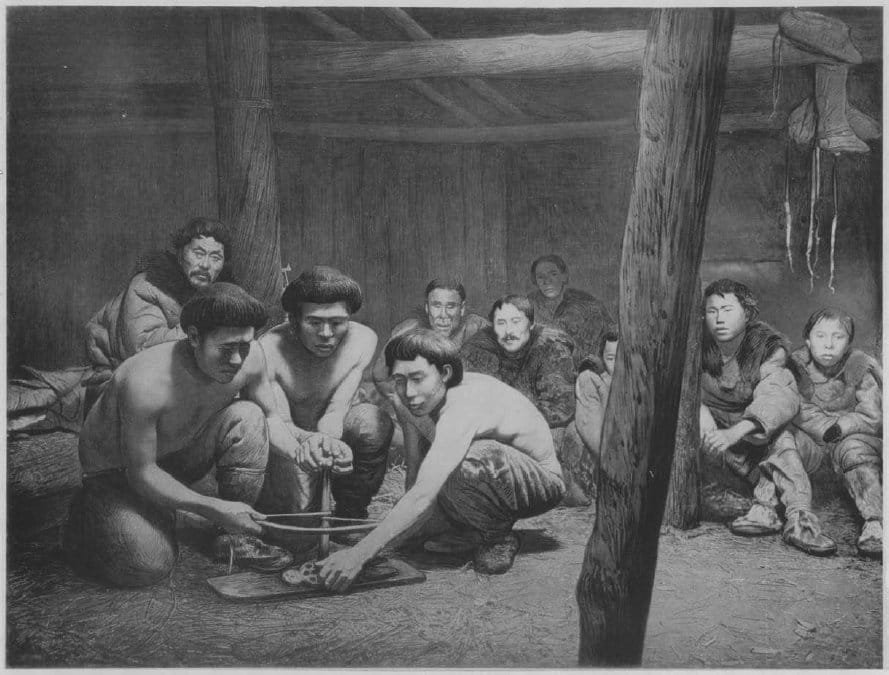
Koryak men at the ceremony of starting the New Fire, photographed during the Jesup North Pacific Expedition — the same fieldwork that recorded fly-agaric use. — Rudolf Weber, AMNH (Jesup Expedition) · Public domain · Source
A northern mushroom world
The Koryak of Kamchatka and the neighbouring Chukchi live in one of the harshest inhabited landscapes on earth, herding reindeer and hunting sea mammals along the edge of the Pacific North. Their mushroom is not a Psilocybe but the scarlet fly agaric, Amanita muscaria, which grows in partnership with the northern birch and conifer.
Wapaq in the ethnographic record
The core evidence is classic ethnography, above all Waldemar Jochelson’s early-twentieth-century study of the Koryak, which records the fly agaric — wapaq — as an intoxicant with ritual and social meaning, hedged by taboo and handled through specialist knowledge.1 Related practices are reported among the Chukchi and other Siberian peoples. This is one of the better-documented Old-World mushroom traditions, and it deserves its place beside the American cases.
Not a psilocybin tradition
The fly agaric works through ibotenic acid and muscimol, not psilocybin, and it is genuinely toxic. Its effects, its dangers, and its ritual logic have little in common with the Mesoamerican or Basotho mushrooms — different chemistry, different practice, a different story. The species page carries the safety detail: Amanita muscaria.
Beware the myths
More invented history clings to this mushroom than to any other — that it was the Vedic Soma, the secret of Norse berserkers, or the origin of flying reindeer and Father Christmas. Some of those ideas are serious but unproven; others are modern folklore. They are examined, and rated, in Was Soma the fly agaric?
Footnotes
-
Jochelson, The Koryak (1905–1908). ↩
The record
Names of the mushroom
| Name | Language | Translation / gloss |
|---|---|---|
| wapaq † | Koryak | — |
Indigenous- and local-language names appear in many spellings across dialects, publications, and orthographies. We record them as given in our sources and do not standardise them or invent translations. A dagger (†) marks a form our sources flag as uncertain.
Historical record
- 1900s
Jochelson's ethnography
Waldemar Jochelson's study of the Koryak documents wapaq (Amanita muscaria) as an intoxicant surrounded by taboo and specialist practice.
Contemporary ethnography - 20th c.
Suppression and change
Soviet-era pressures and broader social change reshape and diminish traditional use.
Historical
Evidence
The support for this entry, separated by kind. Different kinds of evidence carry different weight.
- Contemporary ethnography
- Jochelson, The Koryak (Jesup North Pacific Expedition, 1905–1908).
- Firsthand testimony
- Early observers' accounts of Siberian fly-agaric use.
- Oral tradition
- Reported songs, taboos, and specialist knowledge surrounding wapaq.
What remains uncertain
- The degree of present-day continuity is uncertain and easily romanticised.
Sources & editorial record
Sources & further reading
Waldemar Jochelson (1905–1908). The Koryak. Jesup North Pacific Expedition, Vol. VI, AMNH.
Foundational ethnography documenting Koryak use of Amanita muscaria (wapaq).
Andy Letcher (2006). Shroom: A Cultural History of the Magic Mushroom. Faber & Faber.
A critical cultural history that deflates several popular entheogenic myths — useful precisely where it disagrees with the psychedelic canon.
R. Gordon Wasson (1968). Soma: Divine Mushroom of Immortality. Harcourt Brace Jovanovich.
The influential (and contested) argument identifying the Rigvedic Soma with Amanita muscaria.
Editorial record
Corrections history
No corrections recorded yet. Spotted an error or a mischaracterisation? See how corrections work.
Last reviewed