Evidence & debate
Did the ancient Maya ceremonially use sacred mushrooms?
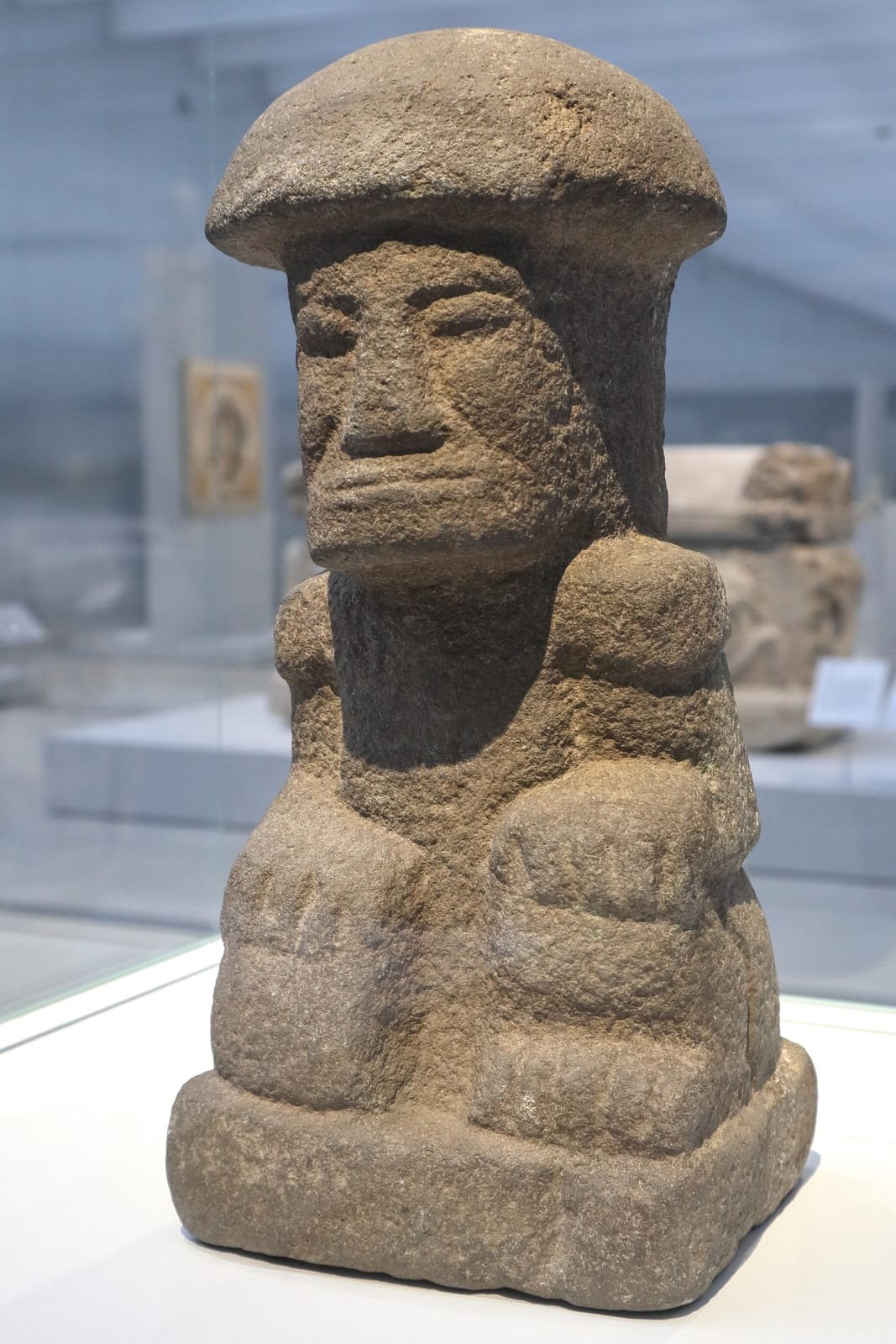
Carved mushroom stones from Guatemala have led some scholars to propose a sacred mushroom complex. Others read the same objects as potters' moulds. No directly observed ceremony survives to settle the argument.
“The ancient Maya worshipped psychedelic mushrooms.”
Strongest case for
Mushroom-shaped stone objects recur across the southern Maya region, some from the Preclassic; de Borhegyi (1961) linked them to a 'mushroom-stone cult' with possible underworld and night-lord associations, and later ethnomycology found supporting symbolic resonances.
Strongest case against
Köhler (1976) reinterpreted the same objects as potters' moulds or anvils; no observed ceremony survives; psychoactive fungi decay fast and leave little direct trace; and proposed mushroom motifs in art are easy to over-read.
The claim, stated fairly
In popular psychedelic history the Maya are often listed, flatly, among the ancient civilisations that “used” sacred mushrooms. The reality is a genuine scholarly question with real evidence on more than one side — which is more interesting than the myth, and more honest.
The strongest case for
The best evidence is material: a class of small carved mushroom stones, some dating to the Preclassic, found across the southern Maya region and highland Guatemala. In 1961 Stephan de Borhegyi argued these demonstrated an ancient “mushroom-stone cult,” and connected them to underworld powers and the nine lords of the night.1 Later writers added iconographic and legendary resonances, including highland Guatemalan lore linking Amanita muscaria to thunder.2 Taken together, this suggests — the verb is deliberate — a ritual mushroom complex somewhere in the Maya sphere.
The strongest case against
In 1976 Ulrich Köhler reinterpreted the same stones as potters’ moulds or anvils, ordinary tools rather than sacred objects.3 If even some mushroom stones are utilitarian, the material foundation of the cult hypothesis weakens sharply. Two further problems compound it: no directly observed Maya mushroom ceremony survives to describe, and psychoactive fungi rot quickly, leaving little for archaeology to find — so the thin record is exactly what we would expect whether or not such rites existed.
Why the record is thin either way
This is the deeper lesson. In the archaeology of psychoactive mushrooms, absence of direct evidence is the normal condition, not a special failure. That cuts both ways: it means the Maya case cannot be disproven by silence, and it means it cannot be proven by a handful of suggestive carvings.
Where it stands
There may well have been a Maya mushroom complex. The stones are real, and strange, and worth taking seriously. But “the Maya worshipped psychedelic mushrooms” claims far more than the evidence supports, while a flat denial ignores what the stones might mean. The question stays open — which is exactly where the scholarship leaves it.
Footnotes
The record
Historical record
- Preclassic
The objects are made
Carved stones in mushroom form are produced in the southern Maya region.
Archaeology - 1961
The cult hypothesis
de Borhegyi argues for an ancient mushroom-stone cult.
Later scholarly interpretation - 1976
The potters' hypothesis
Köhler proposes a utilitarian function, undercutting the ritual reading.
Later scholarly interpretation
What remains uncertain
- No filmed, described, or directly observed Maya psilocybin ceremony exists.
- The mushroom stones have a serious non-ritual explanation.
- The species, dose, setting, and specialists are entirely reconstructed if the ritual reading is accepted at all.
Sources & editorial record
Sources & further reading
Stephan F. de Borhegyi (1961). Miniature Mushroom Stones from Guatemala. American Antiquity 26(4).
Argued that carved mushroom stones evidence an ancient "mushroom-stone cult," linking them to underworld and nine-lords-of-the-night symbolism.
Ulrich Köhler (1976). Mushrooms, Drugs, and Potters: A New Approach to the Function of Precolumbian Mesoamerican Mushroom Stones. American Antiquity 41(2).
The central counterargument: reinterprets mushroom stones as potters’ anvils/moulds rather than ritual paraphernalia.
Bernard Lowy (1974). Amanita muscaria and the Thunderbolt Legend in Guatemala and Mexico. Mycologia 66(1).
Records highland Guatemalan Quiché speakers identifying Amanita muscaria with a word for "thunderbolt" — symbolic resonance, not proof of Classic Maya psilocybin rite.
Congreso de la República de Guatemala (1992). Ley contra la Narcoactividad (Decreto 48-92). Guatemala.
Broadly restricts psychotropics; legal use limited to authorised medical/research contexts.
Editorial record
Corrections history
No corrections recorded yet. Spotted an error or a mischaracterisation? See how corrections work.
Last reviewed