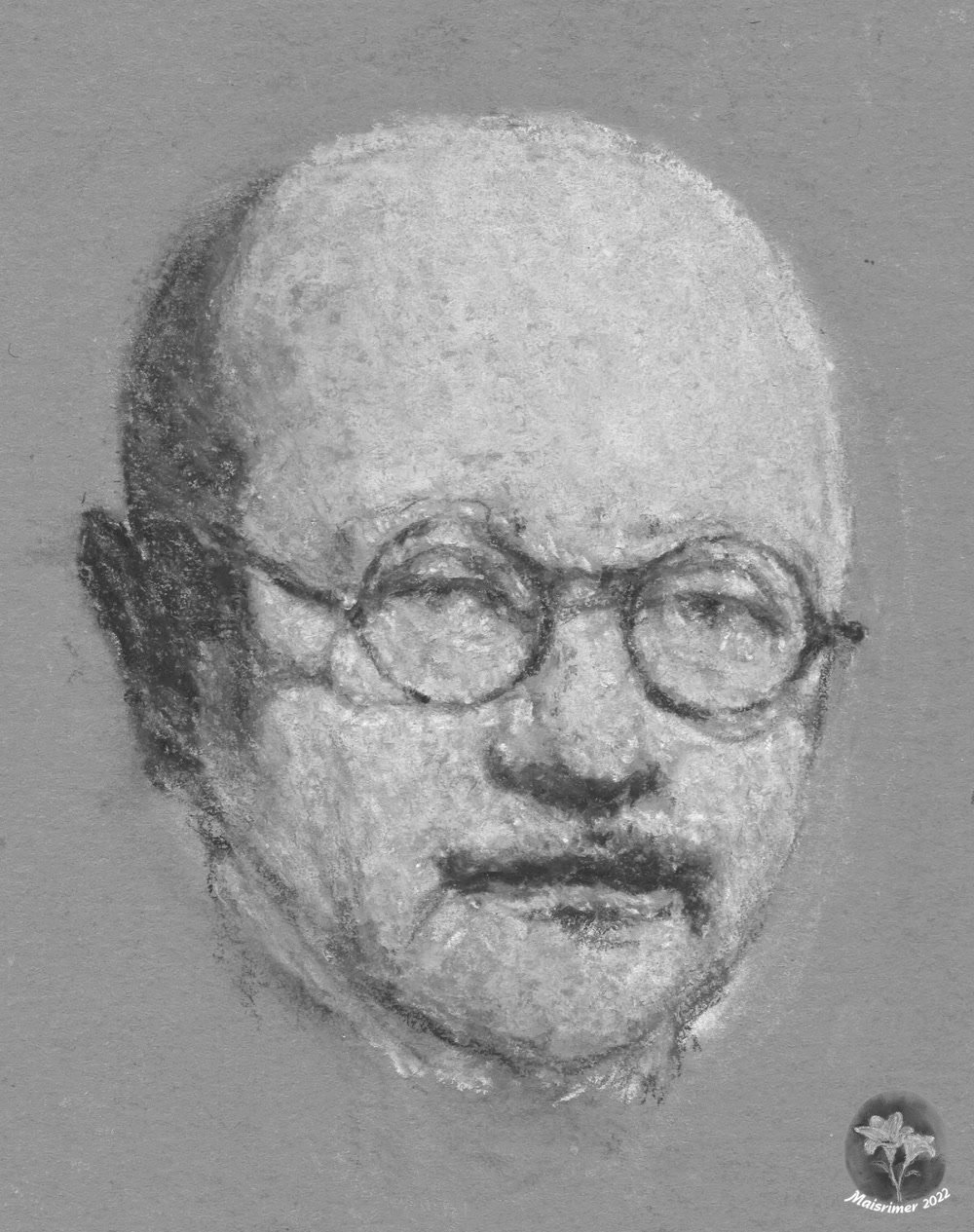
Researcher
Roger Heim
French mycologist; director of the Muséum national d'Histoire naturelle · 1900–1979
The mycologist who gave the sacred Mexican mushrooms their scientific names — and grew them in Paris so a chemist could isolate what made them work. If Wasson brought back the experience, Heim turned it into science.
Naming the holy children
When R. Gordon Wasson returned from the Sierra Mazateca, he had an experience but not a science. It was Roger Heim, director of France’s national natural-history museum, who supplied the mycology. Heim identified and formally described the Oaxacan sacred species — a suite of Psilocybe including P. mexicana — and published them alongside Wasson’s ethnography in Les champignons hallucinogènes du Mexique (1958).1
From mountain to laboratory
Heim did something more practical still: he cultivated the mushrooms in Paris, producing enough clean material to send to Albert Hofmann’s laboratory. Without that cultivated supply there would have been no isolation of psilocybin, and much of the science that followed would have stalled. Heim was the bridge between a ceremony in Oaxaca and a compound in a Swiss flask.1
Why he belongs here
Heim also carried the same questions elsewhere — investigating, with Wasson, the New Guinea “mushroom madness” of the Kuma, where he identified the nonda boletes without ever finding a compound that explained the reported frenzy.2 He belongs here as the field’s mycological backbone: the man who insisted that before you theorise about a sacred mushroom, you had better know exactly which mushroom it is.
Footnotes
The record
Sources & editorial record
Sources & further reading
Roger Heim & R. Gordon Wasson (1958). Les champignons hallucinogènes du Mexique. Muséum national d’Histoire naturelle, Paris.
Heim’s mycological identification of the Oaxacan sacred species alongside Wasson’s ethnographic notes.
Roger Heim & R. Gordon Wasson (1965). La folie des Kuma: le champignon nonda et Boletus manicus. Cahiers du Pacifique.
Heim and Wasson investigate the New Guinea "mushroom madness," identifying nonda boletes (including Boletus manicus) without isolating a compound that explains the reported effects.
Editorial record
Corrections history
No corrections recorded yet. Spotted an error or a mischaracterisation? See how corrections work.
Last reviewed