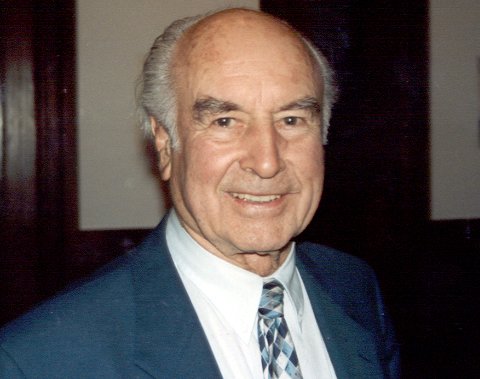
Researcher
Albert Hofmann
Swiss chemist who first synthesised psilocybin · 1906–2008
The Swiss chemist who put a molecule to the mushroom. Having discovered LSD, Hofmann isolated and synthesised psilocybin and psilocin in 1958 from the Mazatec mushrooms — turning a ceremonial sacrament into a defined compound that science could finally study.
The molecule behind the mushroom
Albert Hofmann is remembered first for LSD, which he synthesised in 1938 and famously ingested in 1943. But his place in this archive rests on what he did next. When Roger Heim cultivated the Oaxacan sacred mushrooms in Paris, he sent them to Hofmann’s laboratory at Sandoz. In 1958 Hofmann isolated and named their active principles — psilocybin and psilocin.1 For the first time, the thing the Mazatec called the holy children had a chemical formula.
Why he belongs here
That step matters because it changed what kind of question the mushroom could be. A ceremony can be witnessed; a molecule can be measured, dosed, and tested. Nearly all later clinical work traces back to Hofmann’s synthesis. In 1962 he travelled to the Sierra Mazateca himself, offering his synthetic pills to the curandera who worked with the Wassons — a strange full circle in which the laboratory returned the mushroom’s essence to the mountain that grew it.1
The mythographer, too
Late in life Hofmann lent his chemistry to a bolder claim, co-authoring The Road to Eleusis (1978) with Wasson and the classicist Carl Ruck — the argument that the ancient Greek Eleusinian Mysteries turned on an ergot-based psychedelic potion. It remains unproven and contested, and it shows the same double character that runs through this whole field: the careful scientist and the seeker of a hidden history, in one person.2
Footnotes
The record
Sources & editorial record
Sources & further reading
Albert Hofmann (1980). LSD: My Problem Child. McGraw-Hill.
Hofmann’s memoir, covering his 1958 isolation and synthesis of psilocybin and psilocin from Heim’s cultivated Mexican mushrooms, and his 1962 journey to the Mazatec country with the Wassons.
Roger Heim & R. Gordon Wasson (1958). Les champignons hallucinogènes du Mexique. Muséum national d’Histoire naturelle, Paris.
Heim’s mycological identification of the Oaxacan sacred species alongside Wasson’s ethnographic notes.
R. Gordon Wasson et al. (1978). The Road to Eleusis: Unveiling the Secret of the Mysteries. Harcourt Brace Jovanovich.
The influential proposal that the Eleusinian kykeon was psychoactive — most likely an ergot (Claviceps) preparation. Serious, and unproven.
Andy Letcher (2006). Shroom: A Cultural History of the Magic Mushroom. Faber & Faber.
A critical cultural history that deflates several popular entheogenic myths — useful precisely where it disagrees with the psychedelic canon.
Editorial record
Corrections history
No corrections recorded yet. Spotted an error or a mischaracterisation? See how corrections work.
Last reviewed