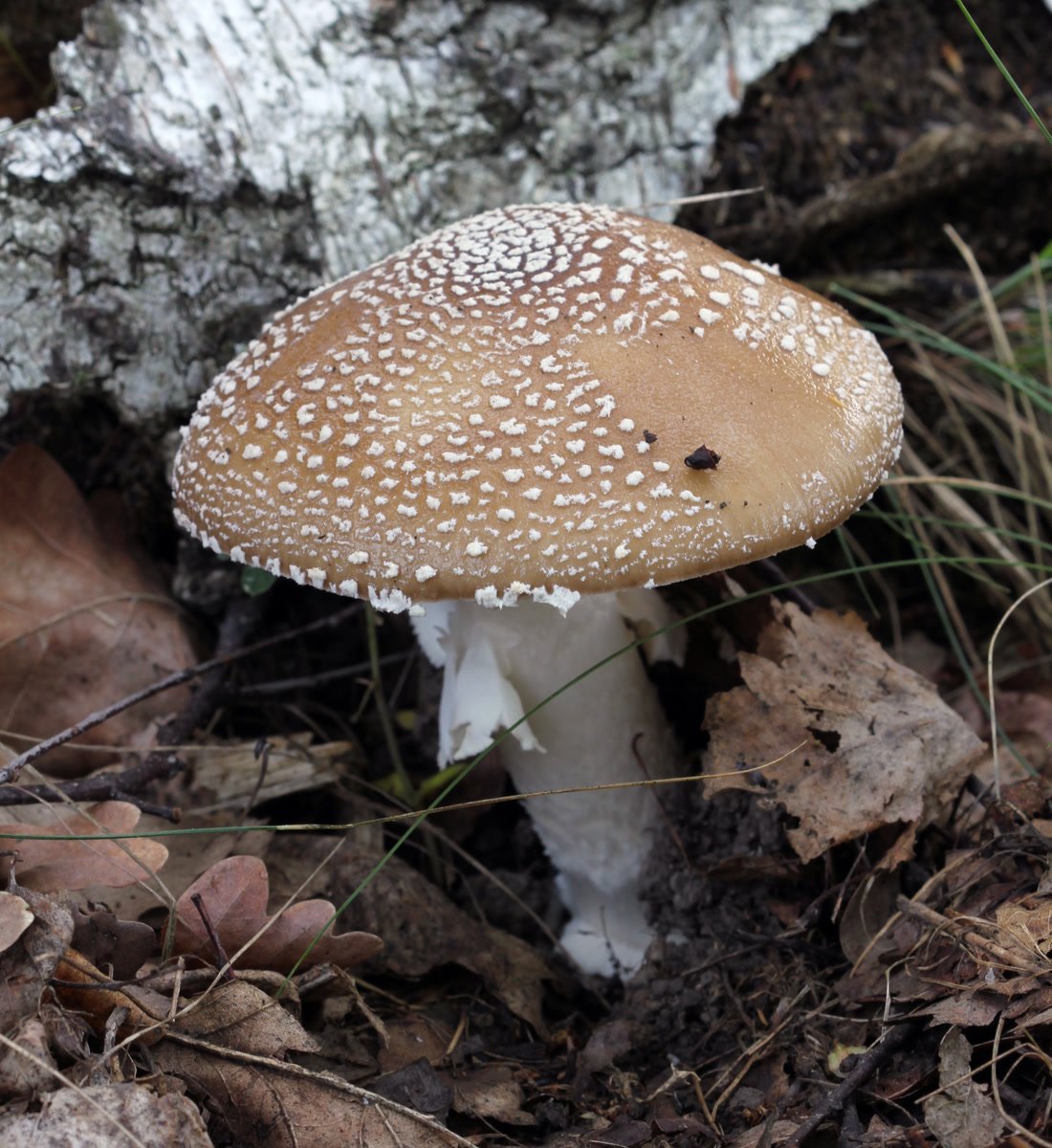
Muscimol / ibotenic acid · Species
Amanita pantherina
(DC.) Krombh., 1836 · Panther Cap, panther amanita
The panther cap — fly agaric's browner, more dangerous cousin. It carries the same muscimol chemistry at higher and more erratic doses, and is a genuinely toxic mushroom that poisons people every year. A muscimol species, not a psilocybin one.
Identification, in outline
Amanita pantherina wears the classic Amanita costume in brown: a warty brown cap, white gills, a ringed stem, and a rimmed basal bulb. It is easily confused with edible brown Amanitas and with its own toxic relatives — a confusion that lands foragers in hospital every year. This is one of the genuinely dangerous mushrooms in this archive.
The fly agaric’s darker cousin
Chemically, the panther cap belongs with Amanita muscaria: its actives are muscimol and ibotenic acid, not psilocybin. But it typically carries them at higher and more erratic concentrations, which makes its effects — and its poisonings — more severe and less predictable than the fly agaric’s.
A quieter history of use
Deliberate use as an intoxicant is recorded here and there — in parts of Japan, where a pantherina-type mushroom appears as tengutake, the “goblin mushroom” — but it is far less documented than fly-agaric use, and far more likely to end in serious toxicity.1 The broader Amanita mythology is examined in Was Soma the fly agaric?
Toxicity and safety
This is the section that matters most. The panther cap causes real, sometimes severe poisonings: agitation, delirium, seizures, and coma have all been recorded. It should be treated as a toxic mushroom, and this page is emphatically not a guide to consuming it.
Conservation
A common woodland mushroom across the northern hemisphere; of no conservation concern.
Footnotes
-
Ott, Pharmacotheon (1993); on the Amanita complex generally, Wasson, Soma (1968), and Letcher, Shroom (2006). ↩
The record
Local names
| Name | Language | Translation / gloss |
|---|---|---|
| tengutake † | Japanese | goblin (tengu) mushroom |
Indigenous- and local-language names appear in many spellings across dialects, publications, and orthographies. We record them as given in our sources and do not standardise them or invent translations. A dagger (†) marks a form our sources flag as uncertain.
What remains uncertain
- The 'panther cap' is a species complex; toxin levels vary sharply between populations and individuals, which is part of why it is so dangerous.
Sources & editorial record
Sources & further reading
Jonathan Ott (1993). Pharmacotheon: Entheogenic Drugs, Their Plant Sources and History. Natural Products Co..
Encyclopaedic survey of entheogens; compiles obscure and historical mushroom cases, including the 17th-century Yurimagua mushroom inebriant reported from the Amazon.
R. Gordon Wasson (1968). Soma: Divine Mushroom of Immortality. Harcourt Brace Jovanovich.
The influential (and contested) argument identifying the Rigvedic Soma with Amanita muscaria.
Andy Letcher (2006). Shroom: A Cultural History of the Magic Mushroom. Faber & Faber.
A critical cultural history that deflates several popular entheogenic myths — useful precisely where it disagrees with the psychedelic canon.
Editorial record
Corrections history
No corrections recorded yet. Spotted an error or a mischaracterisation? See how corrections work.
Last reviewed
A cultural and historical record — not a foraging, cultivation, or consumption guide.