Siberia & the North · Culture
Itelmen (Kamchadal)
Itelmen — 'those who live here'
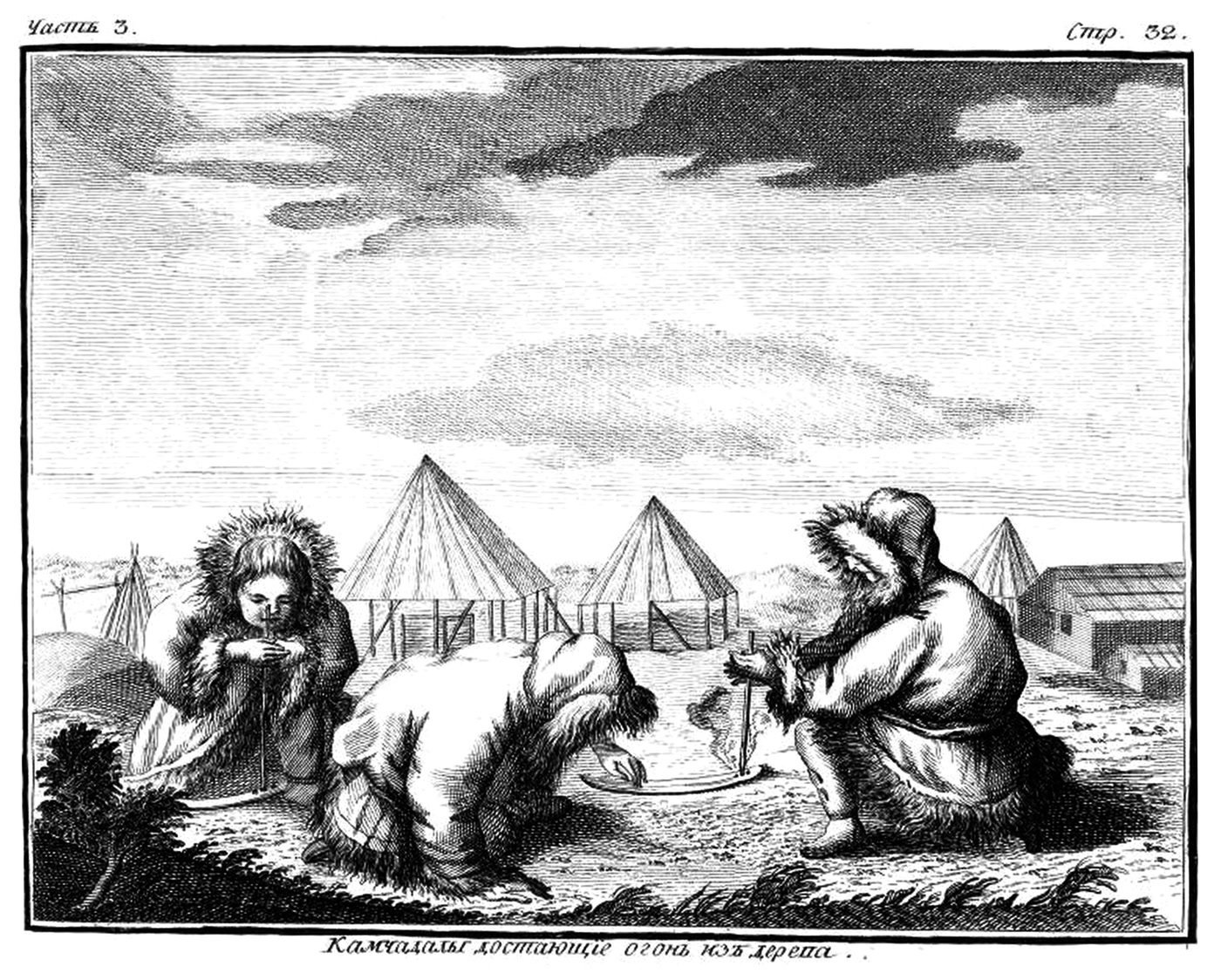
Itelmen making fire, from Krasheninnikov's account of Kamchatka (1755) — the era that produced the first written record of Siberian fly-agaric use. — Engraving from Krasheninnikov, Explorations of Kamchatka (1755) · Public domain (CC0) · Source
Where the record begins
The written history of Siberian fly agaric opens on Kamchatka. When the naturalists of the Russian Second Kamchatka Expedition reached the peninsula in the 1740s, they found the Itelmen (whom the Russians called Kamchadal) and their neighbours using Amanita muscaria as an intoxicant — and they wrote it down.1 Everything the wider world later argued about Soma, berserkers, and shamanic mushrooms traces back, in part, to these pages.
Krasheninnikov’s account
Stepan Krasheninnikov’s Explorations of Kamchatka (1755) describes the mushrooms being dried and eaten, traded at high value to peoples who had none, and — most famously — the recycling of their potency through urine, so that a single flush of mushrooms could pass through several people.1 Georg Steller recorded much the same. These are the founding documents of Old-World ethnomycology.
A tradition mostly in the past tense
The Itelmen were among the peoples most heavily reshaped by Russian colonisation; their language is now critically endangered and a distinct ceremonial practice survives chiefly in these old reports. The archive lists them not to claim a living tradition but to honour where the documentation began — and to keep the fly-agaric story from being told through Kamchatka’s neighbours alone.
Not a psilocybin tradition
The chemistry is muscimol and ibotenic acid — see Amanita muscaria — and the freight of myth around it is weighed in Was Soma the fly agaric?
Footnotes
The record
Names of the mushroom
| Name | Language | Translation / gloss |
|---|---|---|
| fly agaric (mukhomor, in the Russian sources) † | Russian / Itelmen | — |
Indigenous- and local-language names appear in many spellings across dialects, publications, and orthographies. We record them as given in our sources and do not standardise them or invent translations. A dagger (†) marks a form our sources flag as uncertain.
Historical record
- 1740s–50s
Steller and Krasheninnikov
Georg Steller and Stepan Krasheninnikov, on the Second Kamchatka Expedition, describe Itelmen and Koryak fly-agaric use — the founding European reports.
Firsthand testimony - 1755
Explorations of Kamchatka
Krasheninnikov's book carries the detailed account, including trade in the mushrooms and the recycling of their potency.
Firsthand testimony - 18th–20th c.
Assimilation
Russian colonisation and assimilation largely dissolve a distinct Itelmen practice; the language becomes severely endangered.
Historical
Evidence
The support for this entry, separated by kind. Different kinds of evidence carry different weight.
- Firsthand testimony
- Krasheninnikov, Explorations of Kamchatka (1755); Georg Steller's parallel observations.
- Colonial text
- The reports are those of Russian imperial expeditions — outside observers, with their limits and biases.
What remains uncertain
- Almost everything known comes from 18th-century outside observers; the Itelmen voice is nearly absent from the record.
Sources & editorial record
Sources & further reading
Stepan Krasheninnikov (1755). Explorations of Kamchatka (Opisanie zemli Kamchatki). Imperial Academy of Sciences, St Petersburg.
Eighteenth-century account of the Itelmen (Kamchadal) and Koryak — among the earliest European descriptions of Siberian fly-agaric intoxication and the urine-drinking practice.
R. Gordon Wasson (1968). Soma: Divine Mushroom of Immortality. Harcourt Brace Jovanovich.
The influential (and contested) argument identifying the Rigvedic Soma with Amanita muscaria.
Andy Letcher (2006). Shroom: A Cultural History of the Magic Mushroom. Faber & Faber.
A critical cultural history that deflates several popular entheogenic myths — useful precisely where it disagrees with the psychedelic canon.
Editorial record
Corrections history
No corrections recorded yet. Spotted an error or a mischaracterisation? See how corrections work.
Last reviewed