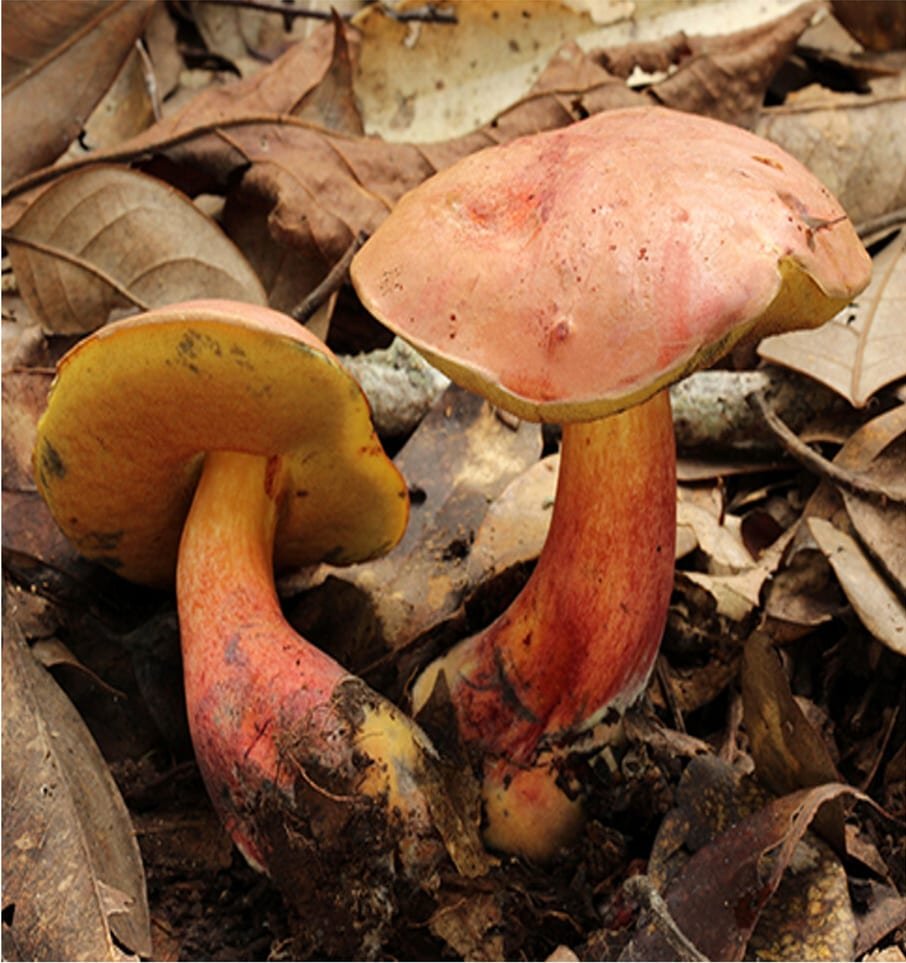
Other · Species
Lanmaoa asiatica
G. Wu & Zhu L. Yang, 2015 · Little-people bolete, 見手青 jiàn shǒu qīng (blue-bruising bolete, Yunnan)
A blue-bruising Asian bolete — no gills, no psilocybin, no muscimol — reported to bring vivid visions of tiny people. Communities in Yunnan, Papua New Guinea, and the northern Philippines describe the same effect independently, and no one yet knows what compound causes it.
A bolete, not a “magic mushroom”
Most of this archive concerns two chemistries: the psilocybin mushrooms and the muscimol-bearing fly agaric. Lanmaoa asiatica belongs to neither. It is a bolete — the sponge-pored, gill-less group whose lineage split from the psilocybin and Amanita mushrooms perhaps 150 million years ago — and analyses have turned up no known psychoactive compound in it at all. And yet it is one of the strangest entries in the whole record of humans and mushrooms.
The effect that shouldn’t happen
Eaten undercooked, this bolete is reported to produce lilliputian hallucinations: the vivid perception of tiny people — often described as two centimetres tall — marching, dancing, working, or teasing the person who sees them. In Yunnan, where blue-bruising boletes (jiàn shǒu qīng) are a prized and sometimes risky delicacy, the “little people” are a well-known folk hazard of a plate that wasn’t cooked through.
Three regions, one vision
What makes the case remarkable is that the same experience is described independently in places with no shared folklore. In the Papua New Guinea Highlands, a mushroom called nonda is tied to episodes early outsiders labelled “mushroom madness”; one elder’s account described tiny people with mushrooms about their faces. In the northern Philippines, a comparable mushroom carries a comparable reputation. Different languages, different continents, the same peculiar, specific vision.
The Yunnan name and the Ming naturalist
The genus Lanmaoa was erected in 2015 and named for Lan Mao (1397–1476), a naturalist of Yunnan whose herbal writing long predates European mycology.1 Leading with that lineage — rather than treating the mushroom as a modern curiosity — keeps the record where it belongs: in the places that have known these boletes for centuries.
An open scientific puzzle
Recent phylogenomic work has sequenced market and herbarium specimens and confirmed the mushroom is a distinct, under-studied lineage — while still finding no identified hallucinogen.2 So the central question stays open: is there an undiscovered molecule here, is the effect a symptom of mild toxicity, or is culture doing part of the work? The competing answers are set out in the debate: The mushroom that shows you little people.
Footnotes
The record
Local names
| Name | Language | Translation / gloss |
|---|---|---|
| 見手青 (jiàn shǒu qīng) † | Chinese (Yunnan) | ‘turns blue when touched’ |
| nonda † | Papua New Guinea Highlands (several languages) | — |
Indigenous- and local-language names appear in many spellings across dialects, publications, and orthographies. We record them as given in our sources and do not standardise them or invent translations. A dagger (†) marks a form our sources flag as uncertain.
What remains uncertain
- The chemistry is a genuine mystery: analyses have not found psilocybin, muscimol, or any known hallucinogen. If the effect is pharmacological, the molecule is undescribed.
Sources & editorial record
Sources & further reading
Gang Wu et al. (2015). Four new genera of the fungal family Boletaceae (incl. Lanmaoa, type L. asiatica). Fungal Diversity 81: 1–24.
Erects the genus Lanmaoa (named for the Ming-era naturalist Lan Mao, 1397–1476) and describes L. asiatica, the blue-bruising Yunnan bolete later tied to "little people" hallucinations.
Colin Domnauer & Bryn T. Dentinger (2026). Phylogenomic systematics of Lanmaoa (Boletaceae) reveals cryptic diversity and suggests a novel psychoactive lineage. Natural History Museum of Utah / University of Utah.
Sequences market and herbarium specimens of the hallucinogenic bolete; finds no known psychoactive compound, pointing to an undescribed molecule behind the lilliputian effect.
Marie Reay (1960). Mushroom madness in the New Guinea Highlands. Oceania 31(2): 137–139.
Classic ethnographic report of "komugl tai" / nonda-associated behaviour among the Kuma of the Wahgi Valley, Papua New Guinea — the anthropological origin of the puzzle.
Roger Heim & R. Gordon Wasson (1965). La folie des Kuma: le champignon nonda et Boletus manicus. Cahiers du Pacifique.
Heim and Wasson investigate the New Guinea "mushroom madness," identifying nonda boletes (including Boletus manicus) without isolating a compound that explains the reported effects.
Editorial record
Corrections history
No corrections recorded yet. Spotted an error or a mischaracterisation? See how corrections work.
Last reviewed
A cultural and historical record — not a foraging, cultivation, or consumption guide.