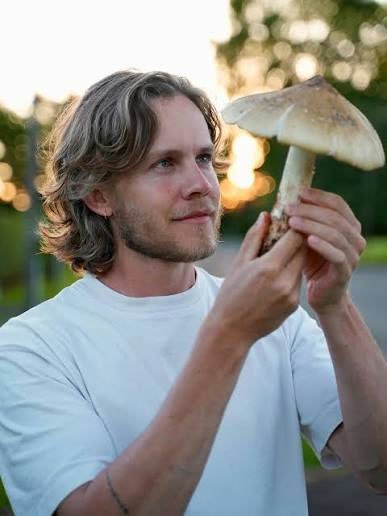
Researcher
Cullen Taylor Clark
Citizen naturalist & field mycologist
A citizen naturalist whose field collecting in the mountains of southern Africa helped bring Psilocybe maluti — and the Basotho tradition around it — into the scientific record, as a co-author on the 2024 description. He is the archive's example of a newer, better way the field can work.
The southern African fieldwork
Cullen Taylor Clark represents a newer kind of figure in this archive: the citizen naturalist whose careful field observation feeds directly into formal science. Working in the Maloti–Drakensberg, Clark was among those who collected and documented the material behind the 2024 description of Psilocybe maluti — the native southern African psilocybin mushroom used by Basotho healers, and the first traditional psychoactive-mushroom practice ever formally documented on the African continent.1
The naturalist’s eye
For most of the twentieth century, describing a new species was the exclusive work of institutions. That has changed. A generation of skilled amateurs — patient observers with a hand lens, a camera, and a habit of looking closely — now feeds the taxonomic record through platforms like iNaturalist and Mushroom Observer, and through direct collaboration with academic mycologists. Clark belongs to that shift. The essential act is the oldest one in natural history: a specimen in hand, turned to the light and truly seen — the moment a photograph can’t fake and an institution can’t outsource.
A better model of credit
What makes the P. maluti work notable is not only the mushroom but the authorship. The 2024 paper credits its citizen collectors alongside academic mycologists and — unusually — names the Mosotho traditional healer Mamosebetsi Sethathi as a co-author rather than an anonymous “informant.”2 It is the collaborative, credit-sharing model this archive hopes to see far more of: the people who hold the knowledge, and the people who do the legwork, named on the science rather than mined for it.
Why he belongs here
Clark is here not as a famous authority but as a template. The history of this subject is heavy with outsiders who took more than they gave — knowledge extracted, communities uncredited, discoveries claimed. The southern African work points the other way: local observers and knowledge-holders as named partners in the record. If the next century of ethnomycology looks more like this, it will be the better for it.
Footnotes
The record
Sources & editorial record
Sources & further reading
University of Cape Town / Stellenbosch University (press summary) (2024). Two new species of Psilocybe mushrooms discovered in southern Africa. Phys.org / ScienceDaily.
Accessible reporting on the 2024 discovery, including how citizen mycologists Talan Moult and Cullen Taylor Clark and healer Mamosebetsi Sethathi contributed to the work.
Breyten van der Merwe et al. (2024). A description of two novel Psilocybe species from southern Africa and some notes on African traditional hallucinogenic mushroom use. Mycologia 116(5).
Formally describes two native southern African species — Psilocybe maluti and Psilocybe ingeli — and reports Basotho traditional use of P. maluti, co-authored with the traditional healer Mamosebetsi Sethathi. The first strong published African case.
Cullen Taylor Cox & and colleagues (2026). Basotho ethnomycology of Psilocybe maluti: interview evidence (preprint). SocArXiv / OSF Preprints.
Interviews with 26 healers and 8 non-healers describing four use domains: initiation, healing, recreation, and magical protection. Not yet peer-reviewed.
Editorial record
Corrections history
No corrections recorded yet. Spotted an error or a mischaracterisation? See how corrections work.
Last reviewed