Southern Africa · Culture
Basotho
Basotho (sing. Mosotho)
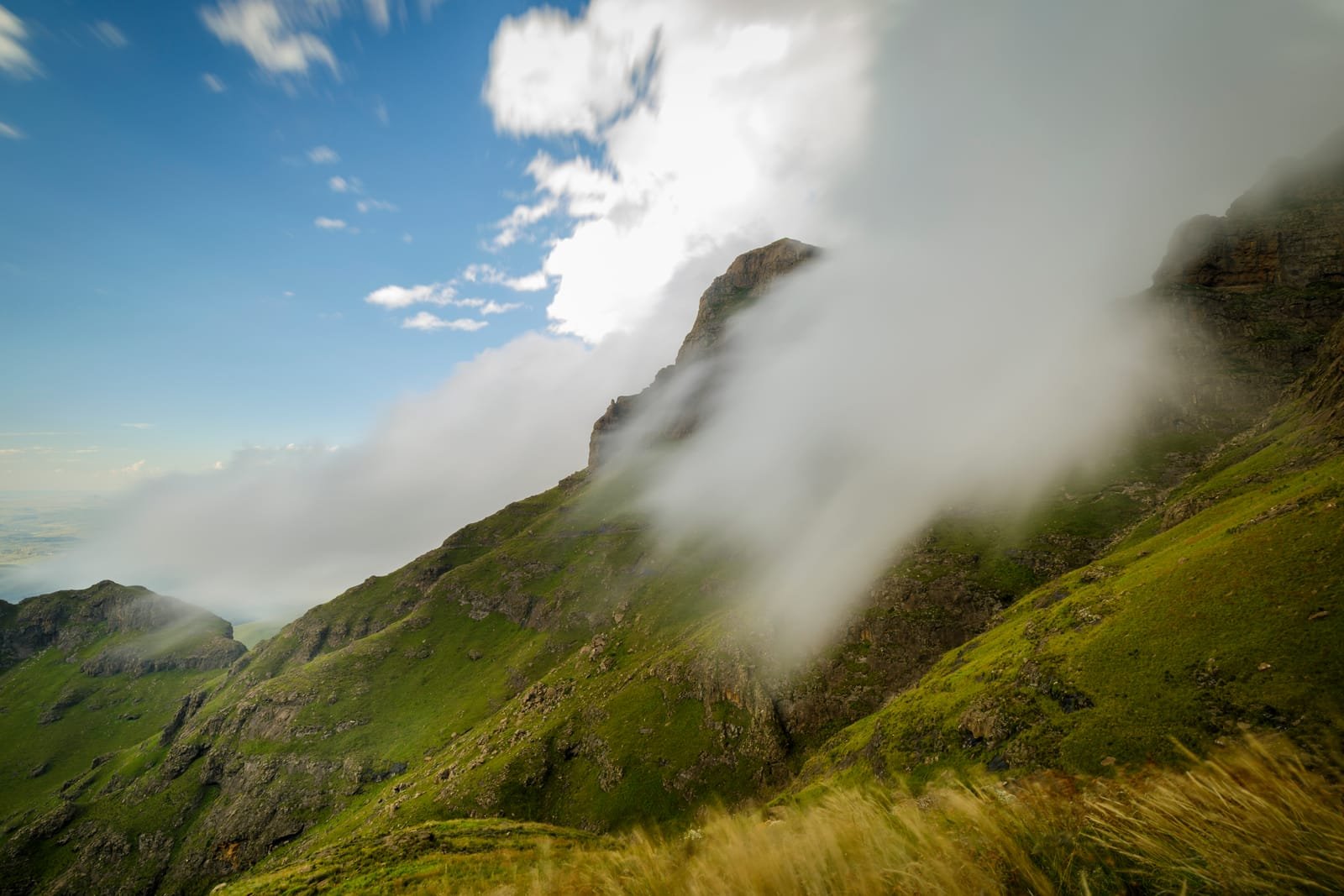
The Maloti–Drakensberg highlands, the mountain world for which Psilocybe maluti is named. — Photo: Thomas Fuhrmann · CC BY-SA 4.0 · Source
Why this case matters
For most of the twentieth century, a tidy story held that traditional serotonergic-psychedelic mushroom use was essentially an American phenomenon — Mesoamerica, perhaps a corner of Siberia for the fly agaric, and little else. The Basotho case punctures that story. In the high grasslands of Lesotho and neighbouring South Africa, healers recognise a native psilocybin mushroom and put it to work inside an existing world of southern African medicine.12
The mushroom and its name
The mushroom is Psilocybe maluti — named for the Maloti mountains — and its Sesotho name in the accessible sources is koae-ea-lekhoaba. Leading with that name, rather than “magic mushroom,” roots the tradition in its own language, which is where an archive should start.
How it reached the record
The 2024 study describes two new southern African species — P. maluti and P. ingeli — but only P. maluti carries the documented tradition.1 What makes the paper unusual is who wrote it. Alongside the mycologists, the citizen naturalists Cullen Taylor Clark and Talan Moult did much of the field collecting, and the Mosotho traditional healer Mamosebetsi Sethathi appears as a co-author rather than a nameless “informant.” That authorship model — the knowledge-holder credited on the science — is exactly the direction this archive wants the field to move.3
Healer roles
The material distinguishes several kinds of specialist: the general healer (ngaka, plural lingaka), diviners associated with foresight (linohe), and herbal specialists (ngaka-chitja).2 The distinction matters because it shows mushroom use living inside a socially differentiated healing world — not a generic, undifferentiated “shaman” role of the kind outsiders too often impose. These terms reach us through a mix of scholarly snippets and derivative summaries, so we present them while flagging that usage varies.
Sethoto and ancestral dreaming
The best-published ceremonial detail concerns sethoto, an initiation brew. Fieldwork summaries report that initiates may consume the foam from the top of the pot to heighten connection with ancestral spirits, and that the mushroom’s ritual force centres on dreams, visions, trance, and foresight.2 That internal logic — long-wave, initiatory, ancestral — keeps the Basotho page from reading like a copy of Mesoamerica. Where the Mazatec meet the mushroom as a speaking voice, the Basotho meet it in sleep, as the nearness of the ancestors — a different face on the same recurring encounter.
A different social pharmacology
The broader account describes Basotho healers using small doses of P. maluti alongside other psychoactive plants, especially Boophone disticha, rather than the large single ceremonial doses familiar from the Mazatec velada.2 Where African mushroom use exists, in other words, it may follow its own pharmacology and its own social form. That difference is one of the most valuable things this case teaches.
Legal status
This was never an internationally famous public sacrament but a low-visibility healer practice. Today, South Africa criminalises psilocybin possession, use, and cultivation, while Lesotho regulates such substances under its 2008 Drugs of Abuse Act; we found no evidence of a formal ritual exemption in either jurisdiction.
Old practice, new documentation
The practice is old; the documentation is new — and, for the ethnographic detail, still a preprint awaiting peer review. The mushroom and its uses were here long before the literature caught up. This is newly documented, not newly invented.
Footnotes
-
van der Merwe, Rockefeller, Kilian, Clark, Sethathi, Moult & Jacobs, “A description of two novel Psilocybe species from southern Africa,” Mycologia (2024). ↩ ↩2
-
Basotho ethnomycology of Psilocybe maluti: interview evidence, preprint (2026). ↩ ↩2 ↩3 ↩4
-
Accessible reporting on the discovery and the citizen-science / healer collaboration (Phys.org / ScienceDaily, 2024). ↩
The record
Names of the mushroom
| Name | Language | Translation / gloss |
|---|---|---|
| koae-ea-lekhoaba † | Sesotho | — |
Indigenous- and local-language names appear in many spellings across dialects, publications, and orthographies. We record them as given in our sources and do not standardise them or invent translations. A dagger (†) marks a form our sources flag as uncertain.
Historical record
- 2024
Two species, and a report of use
Mycologia formally describes two native species — Psilocybe maluti and Psilocybe ingeli — with notes on traditional Basotho use of P. maluti. Unusually, the paper is co-authored with the healer Mamosebetsi Sethathi: the first strong published African case.
Newly surfaced - 2026
Interview evidence
A preprint reports interviews with 26 healers and 8 non-healers describing four domains of use: initiation, healing, recreation, and magical protection. Not yet peer-reviewed.
Newly surfaced
Evidence
The support for this entry, separated by kind. Different kinds of evidence carry different weight.
- Botanical / mycological
- The 2024 formal description of Psilocybe maluti as a native southern African species (Mycologia).
- Contemporary ethnography
- A 2026 interview-based preprint (26 healers, 8 non-healers) — credible but still awaiting peer review.
- Oral tradition
- Healer testimony describing sethoto, dreaming, and ancestral connection.
What remains uncertain
- The literature is very recent; the ethnographic evidence is, as of writing, a preprint rather than a peer-reviewed study.
Sources & editorial record
Sources & further reading
Breyten van der Merwe et al. (2024). A description of two novel Psilocybe species from southern Africa and some notes on African traditional hallucinogenic mushroom use. Mycologia 116(5).
Formally describes two native southern African species — Psilocybe maluti and Psilocybe ingeli — and reports Basotho traditional use of P. maluti, co-authored with the traditional healer Mamosebetsi Sethathi. The first strong published African case.
University of Cape Town / Stellenbosch University (press summary) (2024). Two new species of Psilocybe mushrooms discovered in southern Africa. Phys.org / ScienceDaily.
Accessible reporting on the 2024 discovery, including how citizen mycologists Talan Moult and Cullen Taylor Clark and healer Mamosebetsi Sethathi contributed to the work.
Cullen Taylor Cox & and colleagues (2026). Basotho ethnomycology of Psilocybe maluti: interview evidence (preprint). SocArXiv / OSF Preprints.
Interviews with 26 healers and 8 non-healers describing four use domains: initiation, healing, recreation, and magical protection. Not yet peer-reviewed.
(various) (2023). Traditional healing and psychoactive plants in southern Africa (overview). SciELO South Africa.
Context for the southern African pharmacological repertoire, including Boophone disticha.
Parliament of Lesotho (2008). Drugs of Abuse Act, 2008. LesothoLII.
National framework under which public legal summaries classify psychedelics as illegal in Lesotho.
Parliament of South Africa (1992). Drugs and Drug Trafficking Act 140 of 1992. Republic of South Africa.
Criminalises psilocybin possession, use, and cultivation in South Africa.
Editorial record
Corrections history
No corrections recorded yet. Spotted an error or a mischaracterisation? See how corrections work.
Last reviewed