Evidence & debate
Does a single bolete really cause visions of tiny people — and if so, how?
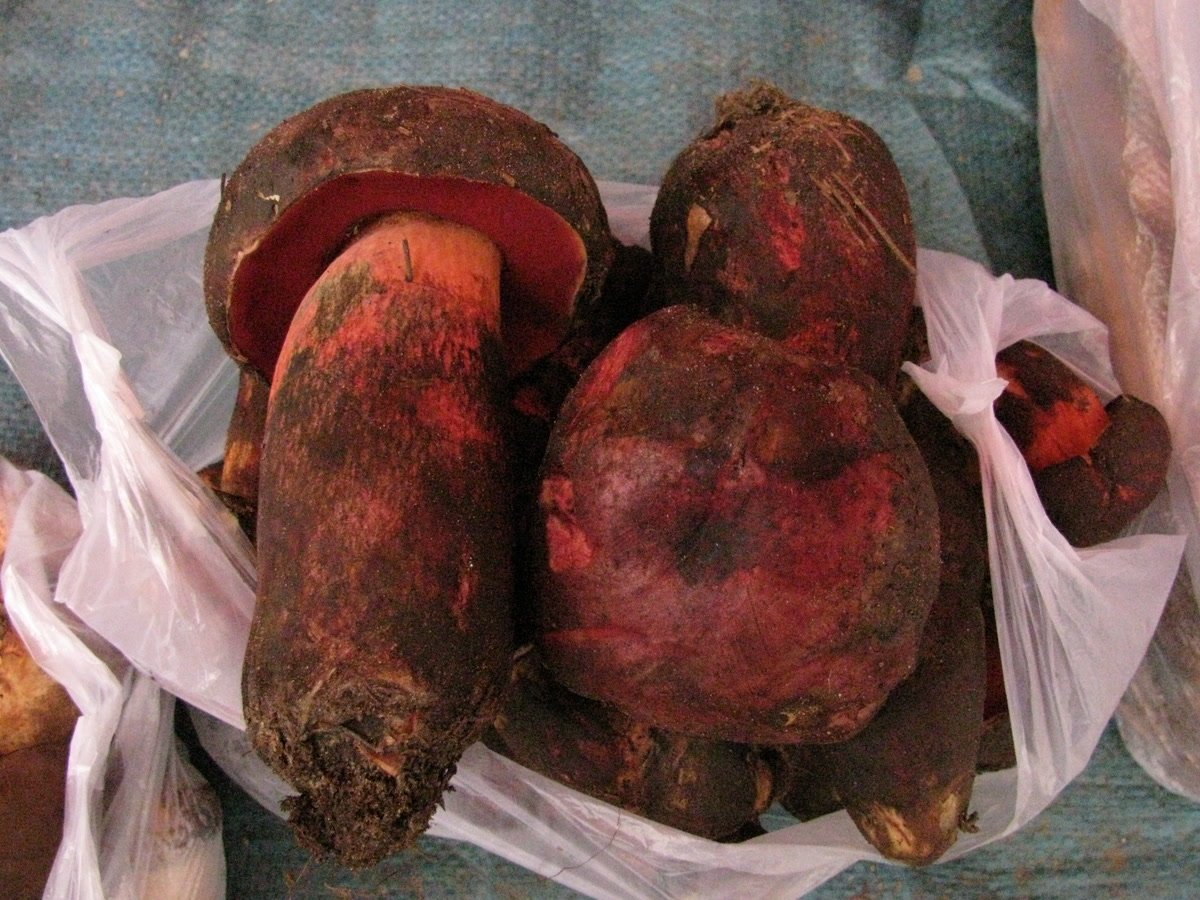
Across Yunnan, Papua New Guinea, and the northern Philippines, people describe the same oddly specific vision — miniature humans — after eating certain blue-bruising boletes. The reports are real and strikingly consistent. The cause is not: no known hallucinogen has been found, and scholars disagree on whether the effect is chemical, toxic, or cultural.
“A newly studied Asian mushroom makes everyone who eats it hallucinate tiny people, proving an unknown psychedelic exists in nature.”
Strongest case for
The 'lilliputian' vision is unusually specific and is reported independently across three regions with no shared folklore; the Yunnan effect is common enough to be a known culinary hazard, and 2026 phylogenomic work treats the bolete as a genuine candidate for an undescribed psychoactive lineage.
Strongest case against
Repeated chemical analyses find no psilocybin, muscimol, or any known hallucinogen; the New Guinea 'mushroom madness' has been read by ethnographers as socially patterned rather than purely pharmacological; and consistency of description can come from shared expectation as much as shared chemistry.
The claim
It is one of the most shareable stories in modern mycology: a mushroom that makes you see tiny people — and, the headline version adds, it contains a psychedelic science hasn’t discovered yet. The first half is better documented than most such claims. The second half is not yet earned.
The case for a real, unified phenomenon
The vision is not vague. Across Yunnan, blue-bruising boletes (jiàn shǒu qīng) undercooked are notorious for producing crowds of small figures — common enough to be a running culinary warning. In the Papua New Guinea Highlands, the nonda mushrooms sit at the centre of episodes that outside observers in the twentieth century called “mushroom madness,” recorded in classic ethnography.1 Parallel accounts come from the northern Philippines. That three separated communities describe the same peculiar, specific experience is the strongest reason to think something real and shared is going on — and 2026 phylogenomic work takes the lineage seriously enough to call it a candidate psychoactive group.2
The case against jumping to a “new psychedelic”
Every chemical analysis so far has come back empty: no psilocybin, no muscimol, no recognised hallucinogen.2 A compound may simply be undiscovered — but “we found no known drug” is not the same as “we found a new one.” Ethnographers have also long argued that the New Guinea episodes are socially scripted — expected behaviour at expected times — as much as they are drug effects.13 And precisely because the little-people motif is so culturally familiar, shared expectation can manufacture shared description. Mild toxicity, individual sensitivity, and preparation may each play a part.
Where it stands
The honest verdict is a split one. The phenomenon — people, in several places, reporting tiny-human visions from these boletes — is well enough attested to take seriously. The explanation is wide open: undiscovered molecule, poisoning symptom, cultural shaping, or some combination. This is exactly the kind of story the archive exists to hold carefully: genuinely astonishing, genuinely unproven, and far more interesting for being left unsolved than for being tidied into a myth.
Footnotes
The record
What remains uncertain
- No causal compound has been isolated. Any claim that a specific new psychedelic has been 'found' is premature.
- The New Guinea nonda boletes and the Yunnan Lanmaoa boletes are relatives grouped together for convenience; they may not be a single species or share a single mechanism.
- Dose, cooking, individual susceptibility, and cultural framing are all plausibly involved, and the studies that would separate them have not been done.
Sources & editorial record
Sources & further reading
Colin Domnauer & Bryn T. Dentinger (2026). Phylogenomic systematics of Lanmaoa (Boletaceae) reveals cryptic diversity and suggests a novel psychoactive lineage. Natural History Museum of Utah / University of Utah.
Sequences market and herbarium specimens of the hallucinogenic bolete; finds no known psychoactive compound, pointing to an undescribed molecule behind the lilliputian effect.
Gang Wu et al. (2015). Four new genera of the fungal family Boletaceae (incl. Lanmaoa, type L. asiatica). Fungal Diversity 81: 1–24.
Erects the genus Lanmaoa (named for the Ming-era naturalist Lan Mao, 1397–1476) and describes L. asiatica, the blue-bruising Yunnan bolete later tied to "little people" hallucinations.
Marie Reay (1960). Mushroom madness in the New Guinea Highlands. Oceania 31(2): 137–139.
Classic ethnographic report of "komugl tai" / nonda-associated behaviour among the Kuma of the Wahgi Valley, Papua New Guinea — the anthropological origin of the puzzle.
Roger Heim & R. Gordon Wasson (1965). La folie des Kuma: le champignon nonda et Boletus manicus. Cahiers du Pacifique.
Heim and Wasson investigate the New Guinea "mushroom madness," identifying nonda boletes (including Boletus manicus) without isolating a compound that explains the reported effects.
Editorial record
Corrections history
No corrections recorded yet. Spotted an error or a mischaracterisation? See how corrections work.
Last reviewed