Evidence & debate
Do the Tassili n'Ajjer paintings depict psychoactive mushrooms?
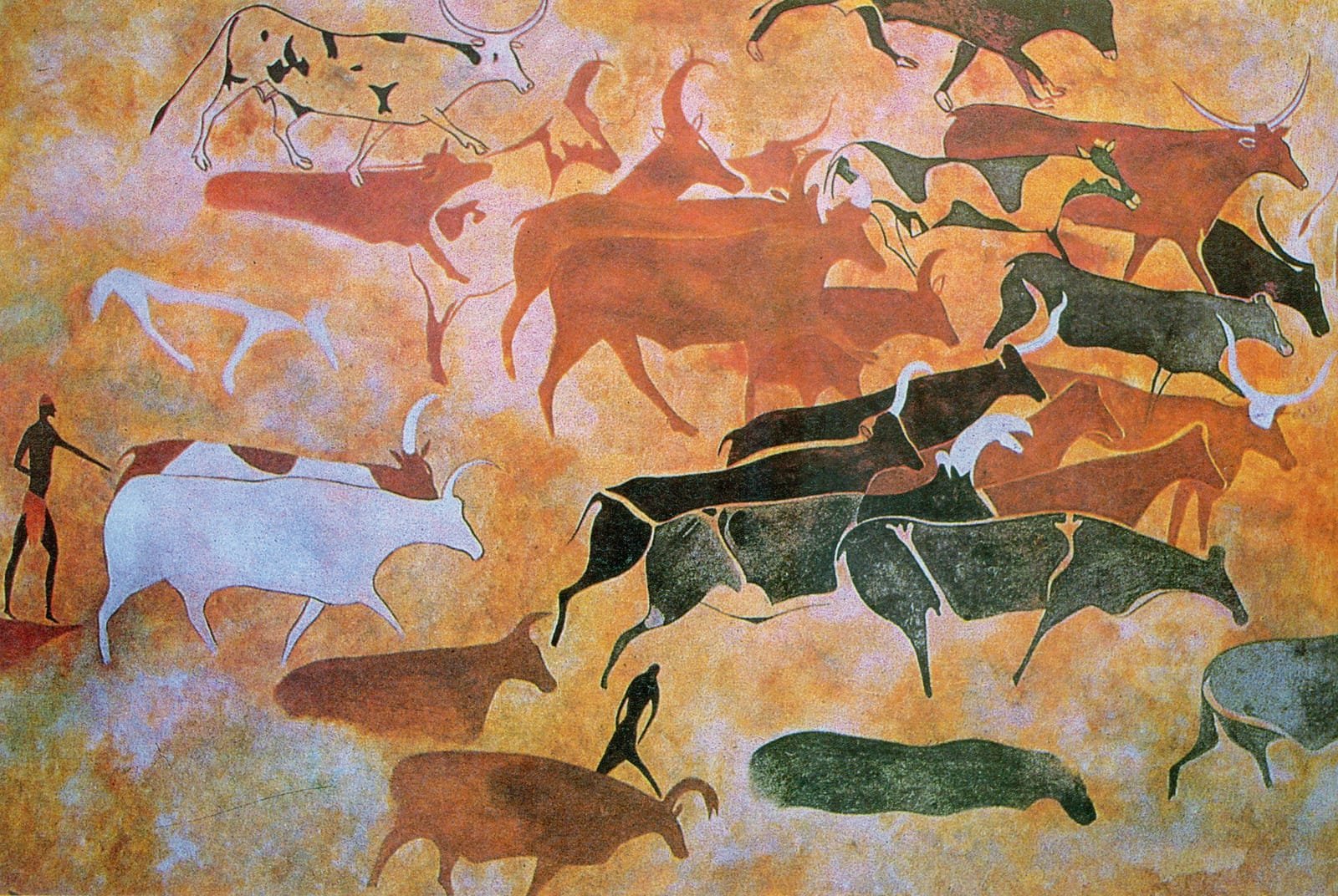
A few Round Head figures have been read as holding mushrooms. The forms are ambiguous, the images are millennia old, and no thread connects them to any known practice.
“Prehistoric Saharan artists painted a mushroom cult nine thousand years ago.”
Strongest case for
Some Round Head figures at Tassili n'Ajjer appear to hold mushroom-like forms, or to have them sprouting from the body; Samorini (1992) read these as the oldest known depiction of hallucinogenic mushrooms.
Strongest case against
The forms are ambiguous and admit other readings; no ethnographic or material chain links the images to mushroom use; dating and cultural context are uncertain; and the case rests on a small number of contested figures.
The claim
Among the thousands of prehistoric figures painted on the Tassili n’Ajjer plateau, a few have become famous in psychedelic circles as the oldest images of sacred mushrooms — proof, the story goes, of a Saharan mushroom cult in the Green Sahara.
The case for
In 1992 Giorgio Samorini argued that certain Round Head period figures hold mushroom-like forms, or have them growing from their bodies, and that dotted and bee-like motifs around them suggest a visionary experience.1 If the reading holds, it would push depicted mushroom use back seven to nine thousand years.
The case against
The forms are ambiguous. The same shapes can be read as stylised plants, arrows, or abstract decoration, and rock art is easy to over-read.2 More decisively, thousands of years and an unknown culture separate the images from any interpreter: there is no ethnographic thread, no material residue, and no way to identify a species. The argument rests on a small, contested set of figures.
Where it stands
The paintings are real and extraordinary. The mushroom reading is one interpretation among several — and, on the evidence available, an unprovable one.
Footnotes
The record
What remains uncertain
- No species can be identified, and no independent evidence of mushroom use survives from the site.
- Rock-art interpretation is notoriously subjective; resemblance is not depiction.
Sources & editorial record
Sources & further reading
Giorgio Samorini (1992). The oldest representations of hallucinogenic mushrooms in the world (Tassili n’Ajjer). Integration: Journal of Mind-Moving Plants and Culture.
The best-known argument that Tassili n’Ajjer rock art depicts mushrooms; treated by later scholarship as disputed.
Andy Letcher (2006). Shroom: A Cultural History of the Magic Mushroom. Faber & Faber.
A critical cultural history that deflates several popular entheogenic myths — useful precisely where it disagrees with the psychedelic canon.
Editorial record
Corrections history
No corrections recorded yet. Spotted an error or a mischaracterisation? See how corrections work.
Last reviewed