North Africa · Culture
Tassili n'Ajjer
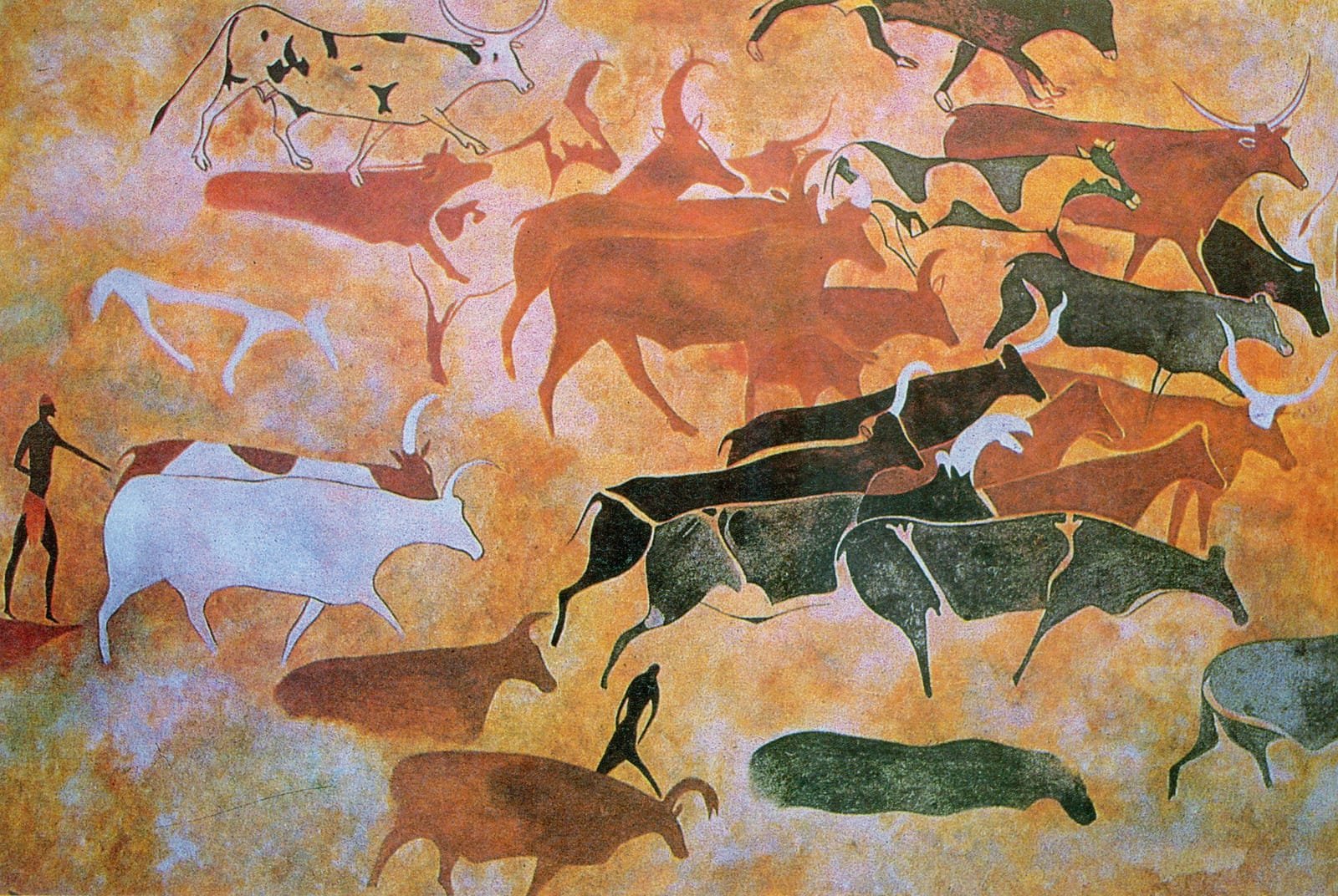
Prehistoric rock painting from the Tassili n'Ajjer plateau — the kind of art at the centre of the mushroom debate. — Scan: Szilas, via Wikimedia Commons · Public domain · Source
The painted plateau
Tassili n’Ajjer, a vast sandstone plateau in the south-eastern Algerian Sahara, holds one of the richest concentrations of prehistoric rock art on earth — thousands of painted and engraved figures across many millennia, from a time when the Sahara was green with rivers and herds. Among the oldest is the so-called Round Head period, whose tall, large-headed human figures have drawn interpretations ranging from the ceremonial to the fantastical.
The mushroom reading
In 1992 the Italian researcher Giorgio Samorini argued that certain Round Head figures hold mushroom-like forms, or have them sprouting from their limbs and heads, and read these as the oldest known depiction of hallucinogenic mushrooms — evidence, he proposed, of a Saharan visionary tradition seven to nine thousand years old.
The case against
The reading is disputed. The painted forms are ambiguous and can be read as stylised plants, weapons, or purely abstract shapes; the figures are cut off from us by thousands of years with no cultural thread to guide interpretation; and the argument turns on a handful of contested images. Prehistoric rock art is famously easy to over-read, and a painted shape that resembles a mushroom is not proof of a mushroom rite.
Where it stands
The strongest arguments on each side are set out in the debate: Do the Tassili paintings depict mushrooms?
The record
Historical record
- c. 7000–5000 BCE
The Round Head paintings
During a wetter 'Green Sahara', artists of the Round Head period cover the plateau with large-headed human figures.
Archaeology - 1992
The mushroom interpretation
Giorgio Samorini reads certain figures as holding or sprouting mushrooms, calling them the oldest such depiction known.
Iconography
Evidence
The support for this entry, separated by kind. Different kinds of evidence carry different weight.
- Iconography
- Round Head figures interpreted by some as holding mushroom-like forms, or with them growing from the body.
- Later scholarly interpretation
- Samorini (1992) reads the forms as mushrooms; other researchers see stylised plants, arrows, or abstract motifs.
What remains uncertain
- The painted forms are ambiguous and admit several readings.
Sources & editorial record
Sources & further reading
Giorgio Samorini (1992). The oldest representations of hallucinogenic mushrooms in the world (Tassili n’Ajjer). Integration: Journal of Mind-Moving Plants and Culture.
The best-known argument that Tassili n’Ajjer rock art depicts mushrooms; treated by later scholarship as disputed.
Andy Letcher (2006). Shroom: A Cultural History of the Magic Mushroom. Faber & Faber.
A critical cultural history that deflates several popular entheogenic myths — useful precisely where it disagrees with the psychedelic canon.
Editorial record
Corrections history
No corrections recorded yet. Spotted an error or a mischaracterisation? See how corrections work.
Last reviewed