Evidence & debate
Did prehistoric Europeans use psychoactive mushrooms?
A few European sites — above all the Selva Pascuala mural in Spain — have been read as evidence of prehistoric mushroom use. The images are suggestive; the case is thin, and no material evidence corroborates them.
“Stone Age Europeans painted and consumed psychedelic mushrooms.”
Strongest case for
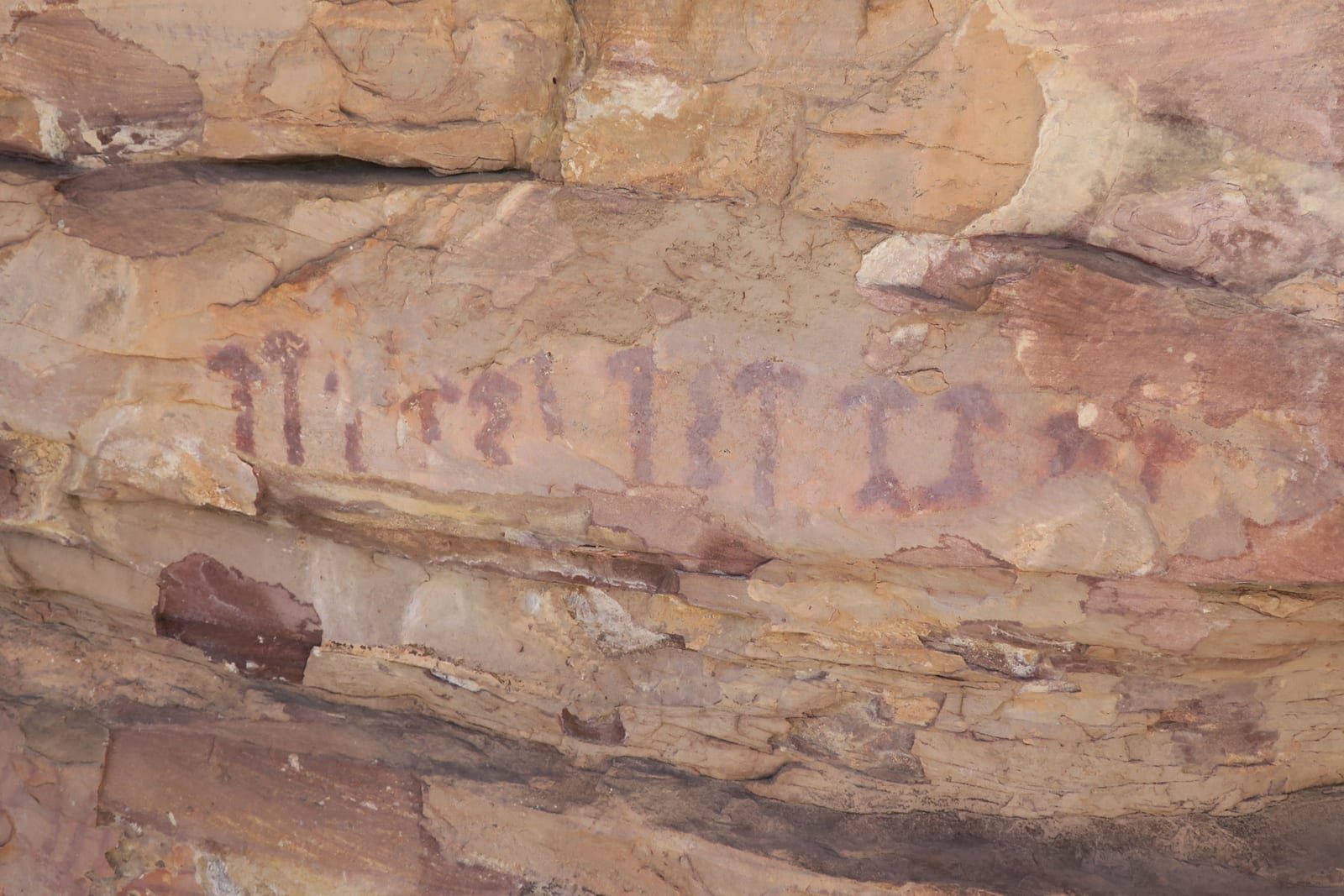
At Selva Pascuala (Villar del Humo, Spain), a row of bell-capped figures beside a bull has been identified by Akers and colleagues (2011) as Psilocybe hispanica, a psilocybin species that grows in the region; scattered motifs elsewhere in Europe have prompted similar readings.
Strongest case against
The painted forms are small, weathered, and schematic, and a species-level identification from them is a large claim; no residue, artefact, or text corroborates prehistoric European mushroom use; and resemblance is not depiction.
The claim
Europe has no velada in its record — no living tradition, no colonial account of mushroom rites. What it has instead is a handful of images, and the hope that they reach back to a lost prehistoric practice.
The case for
The best-known is the Selva Pascuala mural at Villar del Humo, in eastern Spain, perhaps six thousand years old. Beside a large bull runs a row of small, bell-capped figures on stalks. In 2011 Brian Akers and colleagues argued that these depict Psilocybe hispanica, a psilocybin mushroom that still grows in the nearby mountains — which would make the mural a rare prehistoric European record of the species.
The case against
The figures are a few centimetres high, faded, and stylised, and reading a species from them is a stretch not everyone accepts. Nothing else supports the picture: no preserved mushrooms, no residue, no later tradition, no text. As at Tassili n’Ajjer, a painted shape that resembles a mushroom is a long way from proof of a mushroom rite.
Where it stands
The Selva Pascuala reading is worth taking seriously and impossible to confirm. Prehistoric European mushroom use remains a possibility resting on very few ambiguous images — much as it does in the Sahara.
The record
What remains uncertain
- Rock-art interpretation is subjective, and the European cases rest on a very small number of ambiguous images.
- Even if the Selva Pascuala figures are mushrooms, a painting is not proof of use.
Sources & editorial record
Sources & further reading
Brian P. Akers & and colleagues (2011). A prehistoric mural in Spain depicting neurotropic Psilocybe mushrooms? (Selva Pascuala). Economic Botany 65(2).
Argues that a row of bell-shaped figures in the Selva Pascuala mural (Villar del Humo, Spain) depicts Psilocybe hispanica; the identification is debated.
Andy Letcher (2006). Shroom: A Cultural History of the Magic Mushroom. Faber & Faber.
A critical cultural history that deflates several popular entheogenic myths — useful precisely where it disagrees with the psychedelic canon.
Editorial record
Corrections history
No corrections recorded yet. Spotted an error or a mischaracterisation? See how corrections work.
Last reviewed