Europe · Culture
Norse (Berserkers)
Norrœnir menn
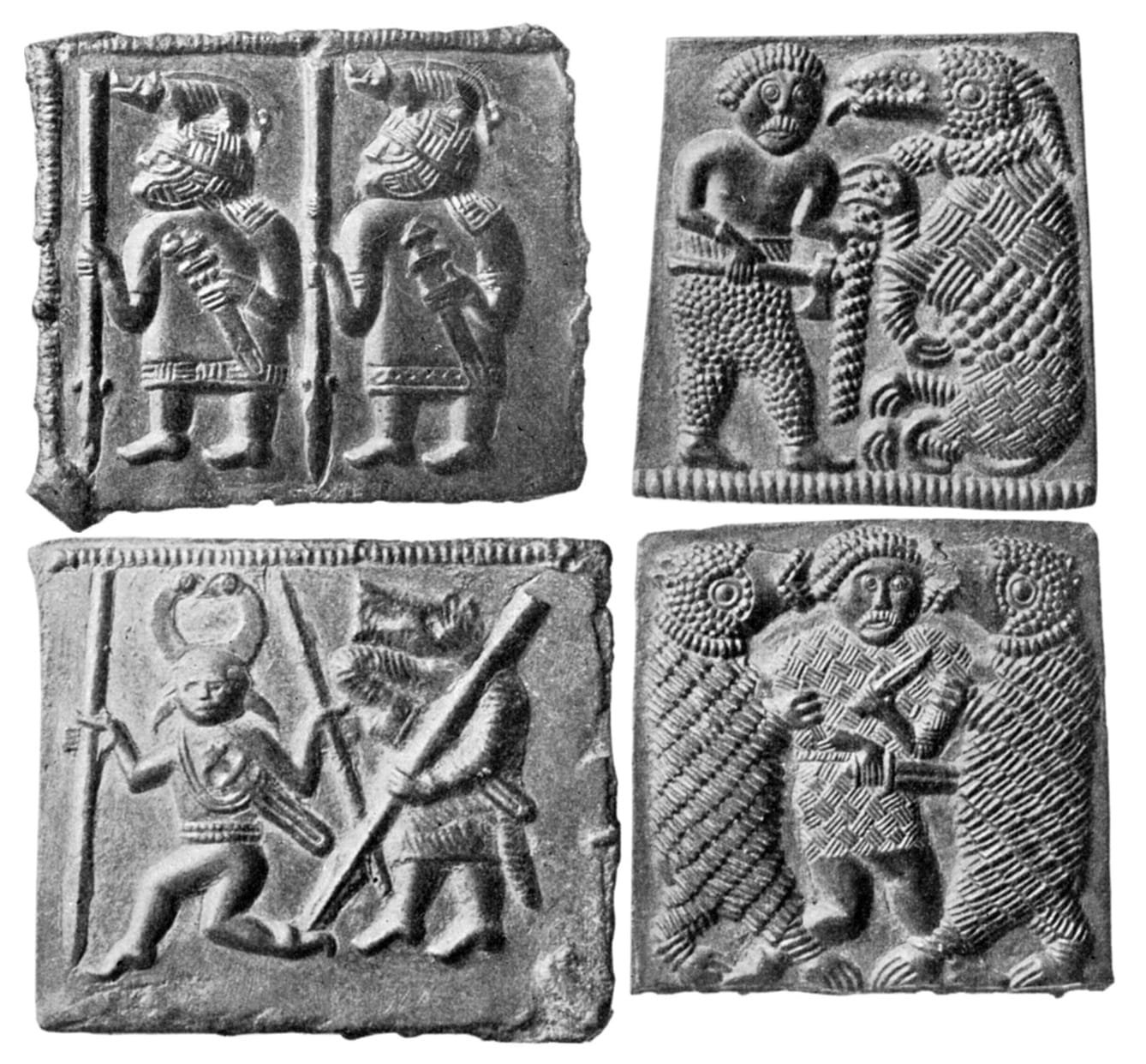
The Torslunda plates — Vendel-era bronze dies whose warrior figures are often linked to berserkers and úlfheðnar. No mushroom appears on them. — Knut Stjerna (1903) · Public domain · Source
The wolf-shirts
The berserkir of the Old Norse sagas were warriors said to fight in a trance of fury — howling, biting their shield-rims, deaf to wounds, “mad as hounds or wolves.” The name may mean “bear-shirt”; their wolf-skinned counterparts were the úlfheðnar. The sagas describe the rage in vivid detail. They never explain where it came from.
The fly-agaric theory
In 1784 the Swedish theologian Samuel Ödman suggested that the berserker frenzy came from eating fly agaric, Amanita muscaria, reasoning by analogy with travellers’ reports of Siberian intoxication. The idea was revived in the twentieth century — notably by the physician Howard Fabing in 1956 — and has circulated ever since as though it were an established fact.
Why most historians doubt it
The evidence is thin to nonexistent. No saga or medieval text links berserkers to any mushroom; the theory is an 18th-century conjecture resting on a Siberian parallel. Historians have offered many other explanations — ritual and psychological preparation for battle, collective frenzy, trauma, drink, or simply a literary convention of the saga age. The fly-agaric story is memorable, endlessly repeated, and poorly supported: a clear case of a good tale outrunning its evidence.
The record
Historical record
- 9th–11th c.
The sagas describe the fury
Old Norse literature depicts berserkir fighting in a trance of rage — but never explains its cause.
Indigenous manuscript - 1784
Ödman's guess
The Swedish theologian Samuel Ödman proposes that the frenzy came from eating fly agaric, by analogy with Siberian reports.
Later scholarly interpretation - 1956
A 20th-century revival
Howard Fabing revisits the theory neurochemically; it enters popular culture as if proven.
Later scholarly interpretation
Evidence
The support for this entry, separated by kind. Different kinds of evidence carry different weight.
- Indigenous manuscript
- Old Norse sagas describe berserker rage vividly but never mention any mushroom.
- Later scholarly interpretation
- Ödman (1784) first proposed fly agaric; Fabing (1956) revived it. Both are conjecture, not medieval evidence.
What remains uncertain
- No saga or medieval source links berserkers to fly agaric, or to any mushroom.
Sources & editorial record
Sources & further reading
Samuel Ödman (1784). An attempt to explain the berserk-rage of the old Nordic warriors through natural history. Kongliga Vetenskaps Academiens nya Handlingar, Sweden.
The original conjecture that Norse berserker fury came from eating fly agaric — an 18th-century idea, not a medieval source.
Howard D. Fabing (1956). On Going Berserk: A Neurochemical Inquiry. Scientific Monthly / American Journal of Psychiatry.
A mid-20th-century revival of the fly-agaric berserker theory; still speculative and widely criticised since.
Andy Letcher (2006). Shroom: A Cultural History of the Magic Mushroom. Faber & Faber.
A critical cultural history that deflates several popular entheogenic myths — useful precisely where it disagrees with the psychedelic canon.
Editorial record
Corrections history
No corrections recorded yet. Spotted an error or a mischaracterisation? See how corrections work.
Last reviewed