Psilocybin · Species
Gymnopilus junonius
(Fr.) P.D. Orton, 1960 · Laughing Gym, spectacular rustgill
The 'Laughing Gym' — a large, bitter, wood-rotting orange mushroom whose psilocybin-bearing forms are linked to one of the oldest written mushroom stories on earth: Japan's waraitake, the laughing mushroom of a thousand-year-old tale.
Identification, in outline
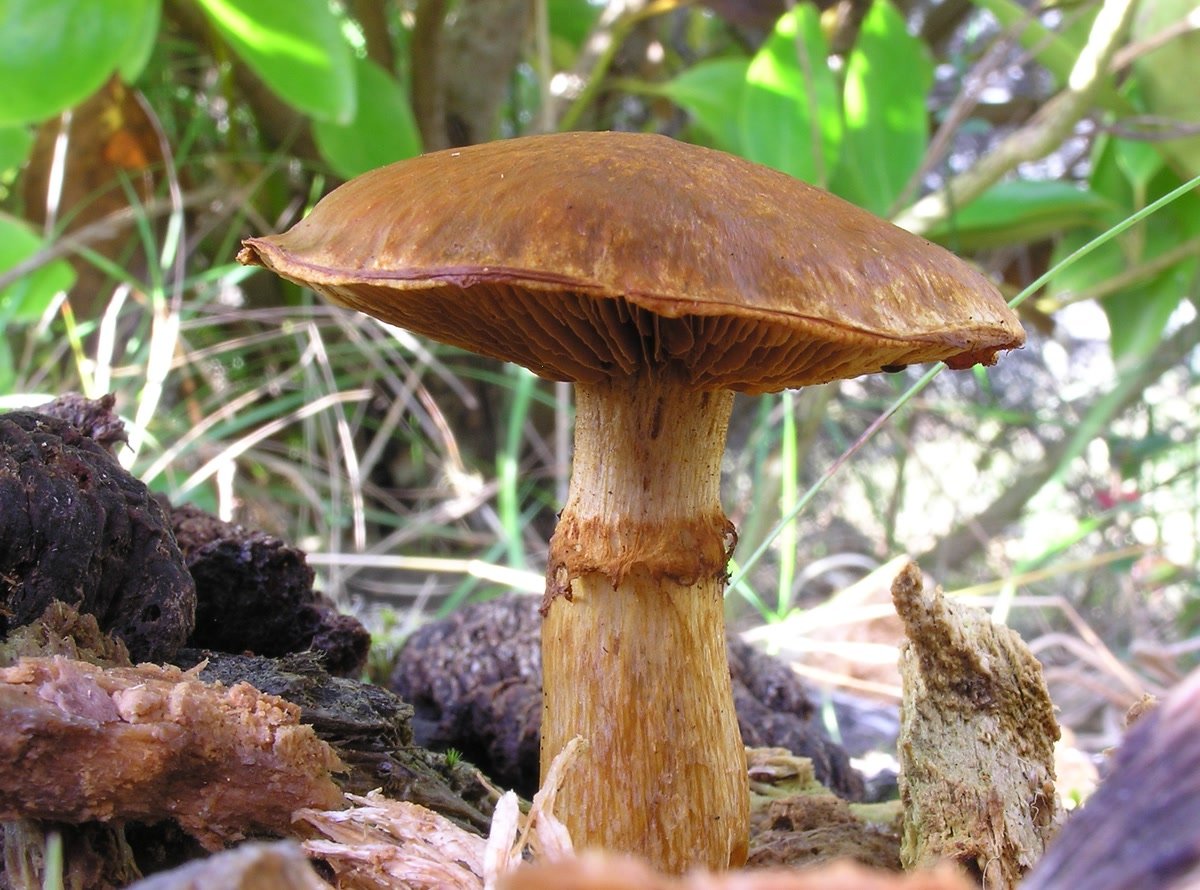
Gymnopilus junonius is hard to miss: big, tawny- to rusty-orange mushrooms in dense clusters on wood, with a rusty spore print and a famously bitter taste. Some populations bruise greenish and contain psilocybin; many do not. That inconsistency is central to its whole story.
The oldest laughing mushroom
Japanese literature preserves one of the world’s earliest mushroom-intoxication anecdotes: in the medieval tale collection Konjaku Monogatari, woodcutters (in some versions, nuns) eat a mushroom, the maitake / waraitake — the “laughing mushroom” — and fall to dancing and laughing helplessly.1 The waraitake is often identified with a psilocybin-bearing Gymnopilus, though it may equally have been a Panaeolus — a nice example of a genuine old text that resists a firm modern label.
Why it is rated disputed
Because so many G. junonius contain no psilocybin at all, and because the historical identification is uncertain, the cultural evidence here is marked disputed. The species is real and its folklore is real; the clean link between the two is not.
Active compounds, toxicity, and law
Where present, the active is psilocybin; the mushroom also carries bitter gymnopilins and is not regarded as an edible. The usual cautions — misidentification, unpredictable potency, legality — apply in full. A cultural record, not a guide.
Conservation
Common on dead and dying hardwood worldwide; of no conservation concern.
Footnotes
-
The Konjaku Monogatari “laughing mushroom” tale, discussed with the Gymnopilus/Panaeolus question in Ott, Pharmacotheon (1993). ↩
The record
Local names
| Name | Language | Translation / gloss |
|---|---|---|
| waraitake † | Japanese | laughing mushroom |
Indigenous- and local-language names appear in many spellings across dialects, publications, and orthographies. We record them as given in our sources and do not standardise them or invent translations. A dagger (†) marks a form our sources flag as uncertain.
What remains uncertain
- Psilocybin content is wildly inconsistent between populations; many collections have none at all, which makes the whole 'laughing mushroom' identification uncertain.
Sources & editorial record
Sources & further reading
Jonathan Ott (1993). Pharmacotheon: Entheogenic Drugs, Their Plant Sources and History. Natural Products Co..
Encyclopaedic survey of entheogens; compiles obscure and historical mushroom cases, including the 17th-century Yurimagua mushroom inebriant reported from the Amazon.
Andy Letcher (2006). Shroom: A Cultural History of the Magic Mushroom. Faber & Faber.
A critical cultural history that deflates several popular entheogenic myths — useful precisely where it disagrees with the psychedelic canon.
Editorial record
Corrections history
No corrections recorded yet. Spotted an error or a mischaracterisation? See how corrections work.
Last reviewed
A cultural and historical record — not a foraging, cultivation, or consumption guide.